Why Is My Website Not Ranking on Google? 15 Common SEO Problems
Is your website not ranking on Google? Discover 15 common SEO problems, from indexing and content to technical SEO, links and local search.
 Kritika Ghimire9 min readUpdated 29 September 2026
Is your website not ranking on Google even though you have published content and optimized your pages? You are not alone. Many businesses find that their website appears far below competitors, or does not appear for important searches at all.
Why is my website not ranking on Google even after I have published content and optimized the pages?
There's rarely a single answer. The problem may be that Google can't access the website, the content is not what people are looking for, important pages are not well structured, or there are technical and local SEO issues.
This is why SEO services in Nepal should begin with identifying the actual problem rather than simply adding more keywords.
Infobytes Nepal's SEO strategy is built around these basics: Technical SEO, Search Intent, On-page Optimization, Content Quality, Internal Linking, Local SEO, Metadata, Sitemap Coverage, and Performance.
Here are 15 common reasons your website may not be performing well in Google Search.
1. Your Website Is Not Indexed Properly
Don't get too concerned with rankings, first make sure that Google can find and index your pages.
If a page is marked with noindex or robots.txt is blocking it or the page is inaccessible to crawlers or other technical issues have occurred, this content may not show up in Search.
Google recommends making sure that search engines can access your important pages and that your website follows its fundamental search requirements. You can review Google's Search Essentials for the core technical, spam-policy, and key best-practice requirements.
2. Your Target Keywords Do Not Match Search Intent
It is not just sufficient to use a keyword. You have to address the purpose of the search query on your page.
Let's say, for instance, a person looks for ‘SEO company in Nepal’ might want to compare services while a person looks for ‘what is SEO’ is looking for educational information.
Your content should reflect what the searcher is looking for.
3. Your Pages Have Weak or Thin Content
If it is composed of just a few generic sentences, a few visitors might not be provided with enough useful information on a page.
This is not to say that you should not keep every page from being too long. Rather, be clear about the service, respond to typical questions, show the relevant skills and provide information to assist visitors in making a decision.
The advice given by Google is to publish content that is helpful, reliable and people oriented, not with the primary motivation of ranking manipulation.
4. Your Title Tags Are Missing or Too Generic
The title is among the first things that users and search engines see.
A title such as “Home” or “Our Services” gives little context. more descriptive title can give the general idea of the page and to whom it is directed.
Clear and descriptive/relevant titles should be assigned to each important page.
5. Your Meta Descriptions Are Weak
Even though a meta description isn't going to ensure ranking boost, it can help clarify the page and urge the proper searcher to click through.
Don't use the same description on each page. Rather, produce a helpful insightful summary that aligns with the service, product or topic.
6. Your Headings Are Poorly Structured
Headings guide the user on how to use a page and inform search engines the structure of a page.
If there's no clear H1, no H2 headings, or no headings that accurately describe what on the page, it will be more difficult to understand.
Use one clear main heading; structure supporting sections in a logical way.
7. Your Website Has Weak Internal Links
include keywords in your internal link text.
Internal links are links that link related pages on your site. Users and search engines might not see the value of an important service page that is not easily found from other pages.
Internal linking strategy is a part of SEO strategy of Infobytes Nepal. Connect relevant blog posts to service pages, product pages, and other helpful resources with descriptive links with anchor text.
8. Your Website Is Slow
People do not enjoy waiting for pages to load, especially on mobile devices. There can be various reasons that lead to poor performance including bad images, unnecessary scripts, configuration of the host machine, and inefficient coding.
Google takes into account overall page experience, and suggests focusing on Core Web Vitals, mobile usability, security and other user experience factors.
9. Your Website Is Not Mobile-Friendly
A website that works well on desktop but becomes difficult to use on a phone can create a poor experience for visitors.
Responsive layouts, readable text, usable navigation, and properly sized buttons are important parts of modern website design.
Google uses the mobile version of a site's content for indexing and ranking under mobile-first indexing.
10. Your Site Has Technical SEO Problems
Technical SEO covers the foundation that allows search engines to crawl, understand, and index your website.
If some of these problems are connected to the website's underlying structure, working with a web development company in Nepal may be necessary alongside SEO improvements.
Common issues include:
- Incorrect canonical URLs
- Missing or poorly configured sitemap
- Broken links
- Duplicate pages
- Incorrect redirects
- Crawlability problems
- Poor URL structure
- Missing structured data where appropriate
These issues are often difficult to spot by simply looking at a website, which is why a proper technical review matters.
11. Your Website Does Not Have Enough Relevant Content
If your business offers several services but has only one general services page, you may be missing opportunities to target specific searches.
For example, a company providing SEO, web development, and digital marketing can create focused pages that explain each service rather than expecting one page to rank for everything.
Infobytes Nepal's own SEO process includes identifying missing pages and content opportunities.
12. You Are Targeting Extremely Competitive Keywords
Some keywords are simply more competitive than others.
A new or relatively small website may find it difficult to compete immediately for broad terms with established websites.
A practical strategy can involve targeting more specific, relevant keywords and building useful content around them before expanding into broader topics.
13. Your Local SEO Signals Are Weak
If you serve customers in Nepal, Kathmandu, or another specific area, local relevance matters.
Your website should clearly communicate where you operate and what services you provide. Consistent business information, relevant location pages, useful service content, and a properly managed Google Business Profile can all form part of a local SEO strategy.
Infobytes Nepal specifically provides local SEO foundations for Nepal-focused businesses.
14. Your Website Has Few Relevant External Signals
Search visibility is not only about what happens on your own website. Relevant mentions, links, and references from other credible websites can help search engines discover and understand your site.
However, buying low-quality links or using manipulative link schemes is not a sustainable SEO strategy. Focus on earning relevant mentions through useful content, partnerships, industry resources, and genuine business activity.
SEO can also work alongside digital marketing services, content planning, and other online activities that help businesses build visibility and attract relevant audiences.
15. You Expect Results Too Quickly
SEO is not an overnight process.
Technical improvements can sometimes produce relatively quick changes, but sustainable organic growth usually requires consistent work on content, technical SEO, search intent, internal links, and measurement.
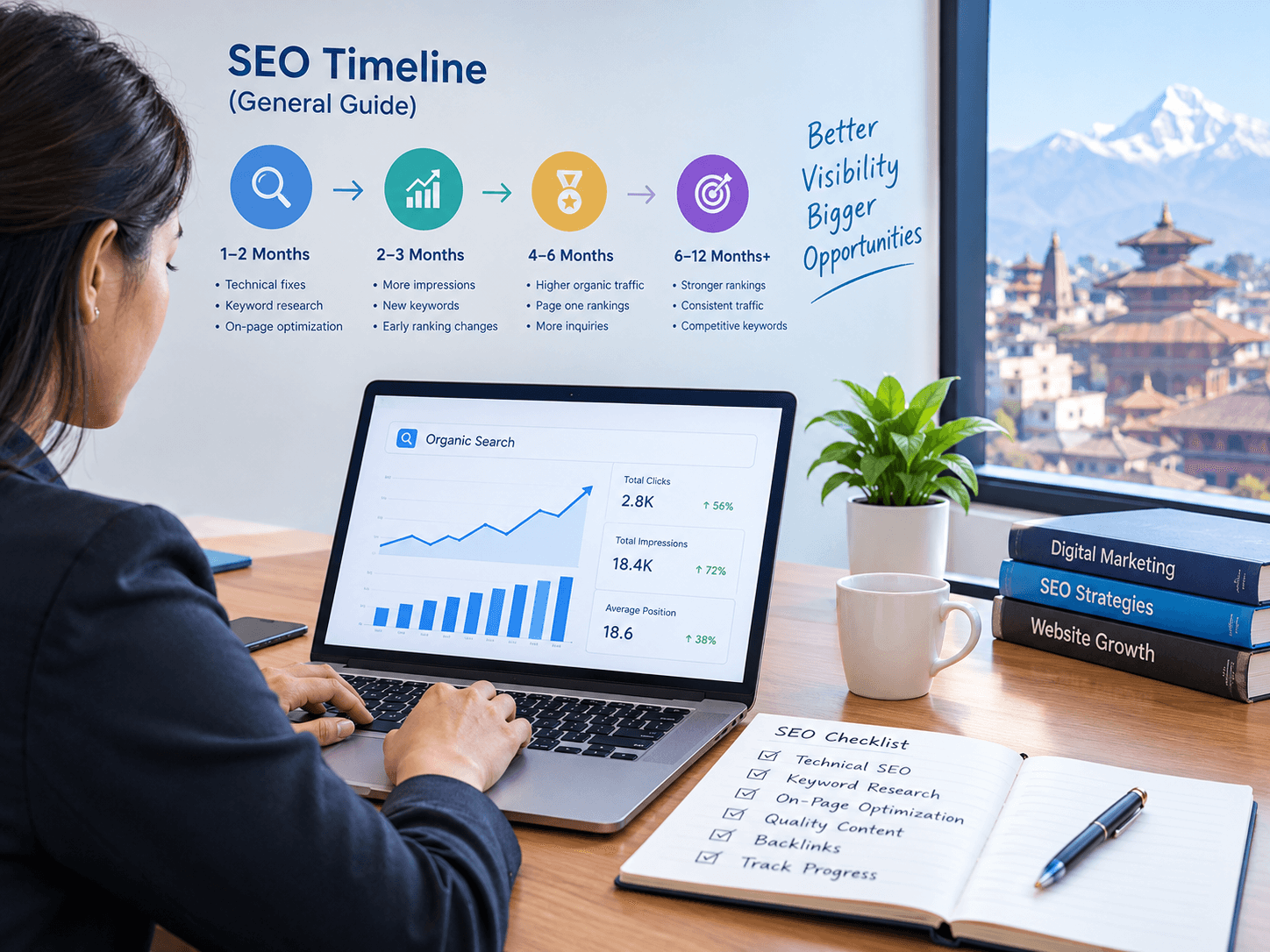
Infobytes Nepal states that SEO results depend on factors such as competition, website condition, content quality, and consistency, and its services page says businesses should generally expect 3 to 6 months to see real movement rather than immediate results.
How to Find Your Website Ranking Issues
If your website is struggling, do not start changing everything at once. Begin with an SEO audit Nepal businesses can use to identify the actual problems.
Check:
- 1Whether important pages are indexed.
- 2Whether your titles and meta descriptions are unique.
- 3Whether your H1 and headings match the page topic.
- 4Whether your content matches search intent.
- 5Whether important pages have internal links.
- 6Whether the website works properly on mobile.
- 7Whether pages load efficiently.
- 8Whether your sitemap and canonical URLs are correctly configured.
- 9Whether your website has relevant local information.
- 10Whether you are tracking organic performance.
- 11This approach is more useful than randomly adding keywords to pages.
When Should You Get a Technical SEO Review?
If you have already published useful content but your website still receives very little organic visibility, technical issues may be part of the problem.
A technical SEO Nepal review can look at crawlability, indexing, page structure, sitemap coverage, canonical URLs, performance, and other technical foundations. Likewise, an on-page SEO Nepal review can examine titles, headings, content, search intent, internal links, FAQs, and other page-level elements.
The goal is not simply to make a website contain more keywords. It is to make the website easier for Google to understand and more useful for the people visiting it.
Conclusion
There are times when adding more keywords isn't the solution if your site is not ranking on Google.
It could be that you have indexing issues, poor content, a mismatch in search intent, technical issues, slow pages, weak internal linking, a lack of local signals, or unrealistic expectations on how fast SEO works.
The first step in the right direction is to determine what are truly the website ranking problems and fix them in the correct order.
The structured SEO audit can provide you with a better idea of what is working and what is not on your pages, and which things should be worked on first.
Technical SEO, relevant content, local relevance, great site architecture and regular measurement are far more pragmatic to build a long-term search visibility strategy for businesses in Nepal.
Frequently Asked Questions
Why is my website not ranking on Google?
All of these can be reasons for your website not ranking including indexing problems, low or thin content, low search-intent match, technical SEO problems, poor internal link structure, slow page speed and high competition with your target keywords. An SEO audit will be able to help you find out what problems are impacting on your website.
How long does it take for a website to rank on Google?
No time limits are set. The results are based on consistent, good technical work, quality of website content, competition, and website condition. There may be some technical changes that will make a significant improvement in a relatively short time; however, organic growth is more likely to come from the ongoing efforts of SEO over several months.
Can adding more keywords improve my Google ranking?
Not necessarily. Including keywords that don't enhance usefulness and relevance of the page can make it harder to read, and may not solve the actual problem. The page must be oriented towards answering the searcher's question or fulfilling his needs and at the same time must be oriented to the keywords used.
What should an SEO audit check?
An SEO audit can be used to review indexing issues, technical issues, page titles, meta descriptions, headings, content quality, search intent, internal linking, sitemap coverage, canonical issues, page performance, mobile usability and local search opportunities.

Written by
Kritika Ghimire
SEO & Digital Marketing Intern
Kritika works on search visibility and the content behind it, and writes about what actually moves a page up the results for a business in Nepal.
More about Kritika