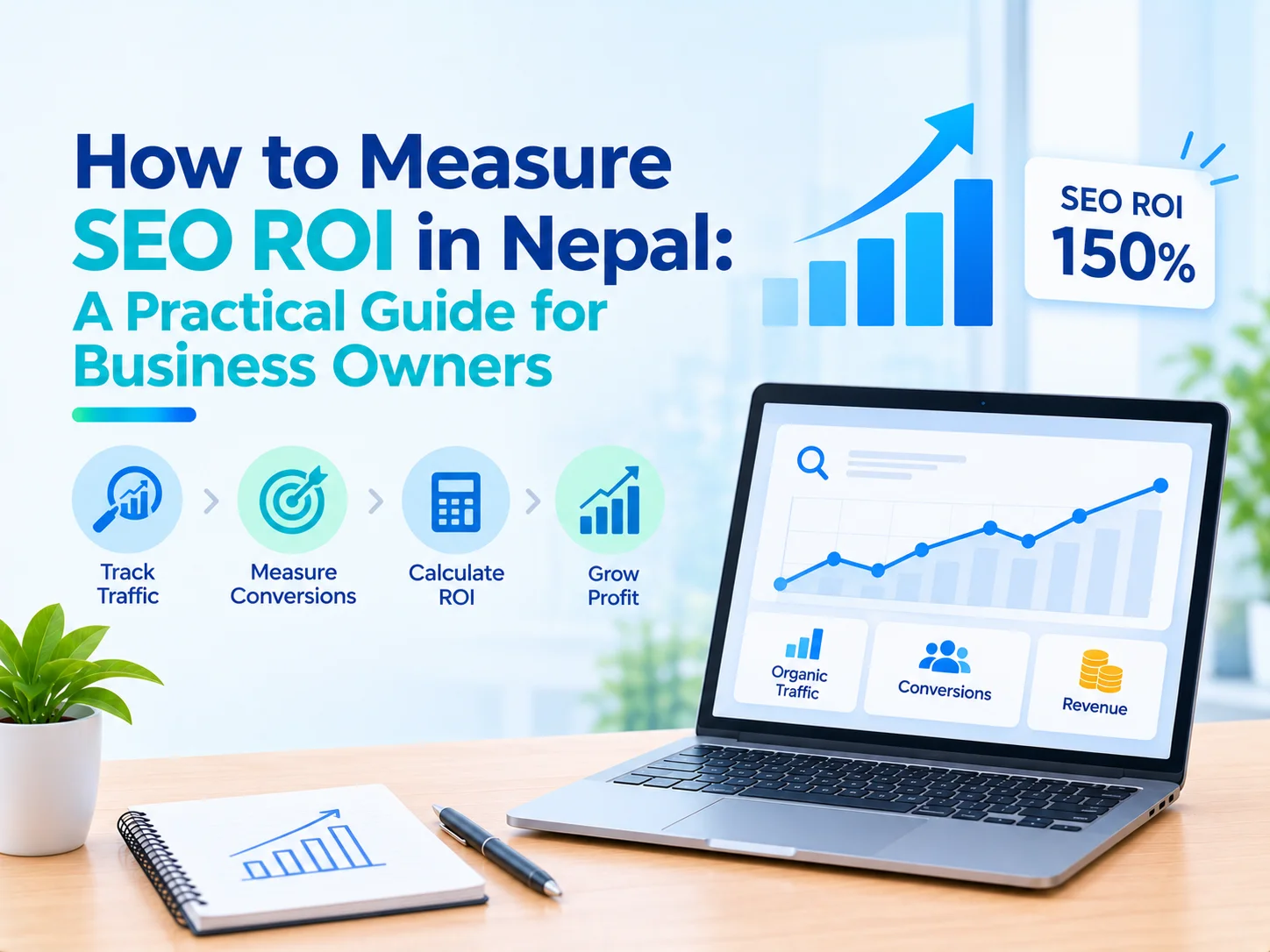
How to Measure SEO ROI in Nepal: A Practical Guide for Business Owners
Learn how to measure SEO ROI in Nepal using organic traffic, qualified leads, conversions, revenue, and reporting to evaluate business results.
 Kritika Ghimire7 min read
Companies use SEO to make themselves more visible online. But just because you're ranked higher and have more traffic on your website doesn't guarantee that your SEO campaign is profitable.
It's possible that a business could get thousands of visitors and only one qualified inquiry. The other could see more visits, but lose a couple of valuable customers.
Business owners can assess the value of organic search in Nepal by grasping the concept of SEO ROI. The understanding of SEO ROI in Nepal can help business owners determine if organic search can drive results.
Businesses should not just associate SEO with people looking for keywords, but with requests, sales, and the value that the customer will bring to the company.
What Is SEO ROI?
The ROI of SEO is the ratio of value from organic search to the cost of SEO activities.
Costs can involve content production, enhancements, website updates, tools, and agency or employee time.
Return can be sales from organic search activity or the worth of qualified leads.
The basic calculation is:
SEO ROI = (SEO-attributed revenue − SEO investment) ÷ SEO investment × 100
For example, if a business invests NPR 40,000 in SEO and attributes NPR 100,000 in revenue to organic search, the simplified ROI is 150%.
However, revenue is not the same as profit. A more meaningful assessment may use gross profit instead, particularly when delivery costs are significant.
1. Define What Success Means
Outline the desired outcome of your SEO before taking any measurements.
A construction company can prioritize on a quotation request, whereas an online store can focus on completed purchases.
A consultancy could count reserved consultations or qualified phone enquiries.
For SEO lead generation in Nepal, the most useful outcome is usually a genuine potential customer rather than an anonymous page view.
Select goals that are meaningful and record the ways in which each one will be evaluated.
2. Measure Organic Search Traffic
Organic traffic are the visitors that come in from the search engine's results pages via natural means.
Google Analytics can help businesses gain insight into visitors' behaviour on the website and the traffic that comes from organic search.
Google Search Console provides data on the number of clicks, impressions, and queries on search results.
When you measure SEO performance, check out trends and not just daily changes.
The competition, holidays, customer preferences and seasonality can also cause the traffic to fluctuate.
Traffic is great but won't create business value.
3. Track Valuable Website Actions
SEO conversion tracking connects website visits with actions that matter to the business.
Examples include submitted enquiry forms, completed purchases, appointment bookings, and relevant phone enquiries.
Set up measurement so that successful actions are recorded rather than simply counting visits to a contact page.
Google's official Analytics key events guidance explains how important user actions can be marked and measured.
Test tracking regularly to confirm that actions are recorded correctly.
Businesses should also follow applicable privacy requirements when collecting analytics data.
4. Separate Enquiries from Qualified Leads
Not all enquiries are converted into customers.
Students can send a message to a business requesting an internship, suppliers can send a message providing services and visitors can send a message in a form unrelated to the business.
If you count any enquiries as a success, this can overestimate results.
To have a realistic idea of the organic traffic ROI, segment inquiries by relevance and buying interest.
For instance, a web development company may differentiate a business quotation and request from a general enquiry regarding how to learn programming.
This will help decision makers better understand SEO reporting.
5. Connect Leads with Actual Sales
A website enquiry is only one stage of the customer journey.
Businesses should track whether leads receive follow-ups, progress through discussions, and become paying customers.
A consistent process helps identify which organic search enquiries produce revenue.
Organizations handling many leads can explore CRM software in Nepal to understand how customer records and follow-up activities can be organized.
Attribution is imperfect. Customers may discover a company through Google but later return through another channel.
Use consistent attribution rules and acknowledge uncertainty in reports.
6. Calculate the Full SEO Investment
Sometimes, businesses focus on the results of SEO and do not see beyond the monthly fee of the agency.
But the investment in SEO must also take into account the SEO cost vs results.
Add in appropriate expenses for content production, technical adjustments, website development, search engine optimization software and in-house staff time.
Do not estimate non-marketing expenses as being SEO related.
If several channels are involved with a project, record the project costs for each channel.
Businesses can explore SEO services in Nepal when assessing which activities may be included in an SEO program.
A complete cost picture supports more realistic decisions.
7. Use Profit-Based Calculations Where Possible
Assume the business has invested NPR 60,000 and credits NPR 150,000 sales to organic search.
The simplified return with using the revenue is 150%.
However, when gross margin on such sales is 40%, then the attributable gross profit is NPR 60,000.
The return based on gross profit, after considering the NPR 60,000 investment in SEO, comes to around 0%.
This example demonstrates how revenue-based ROI can appear higher than the actual numbers.
If your business has a long sales cycle, don't forget to evaluate customer lifetime value, but be sure you aren't counting on unknown future sales as a sure thing.
8. Compare SEO With Other Marketing Channels
Organic search is usually not the only source of traffic that businesses rely on. Advertisements, referrals, social media and direct visitors also can bring customers.
Comparing digital marketing ROI in Nepal across channels can help businesses decide how to allocate resources.
However, different channels have different roles.
Paid advertising may produce immediate visibility, while SEO can continue attracting relevant visitors after publication, provided pages maintain search visibility.
Businesses can review digital marketing services in Nepal when planning coordinated measurement across channels.
9. Turn Reports into Business Decisions
A useful SEO report should answer practical questions.
- Which pages attract qualified visitors?
- Which services generate enquiries?
- Where do potential customers leave without taking action?
Businesses should identify content that attracts traffic but does not support their goals.
An informational article may contribute indirectly by introducing the brand, even if it generates few immediate sales.
When visitors struggle to complete enquiries, web development services in Nepal may help address website usability barriers.
Reporting is most valuable when it guides specific improvements.
Common SEO Measurement Mistakes
Common mistakes include treating rankings as revenue, ignoring lead quality, using incomplete cost figures, and assuming every conversion came from the last recorded channel.
Businesses should also avoid presenting estimated results as confirmed sales.
Accurate reporting builds trust and makes future marketing decisions easier.
Conclusion
Tracking website traffic and keyword rankings isn't enough to measure SEO ROI in Nepal.
Organic search needs to be linked to meaningful enquiries, sales, expenses and realistic profit projections.
Setting goals, evaluating conversion tracking, tracking the results of leads generated by SEO, and consistently analyzing performance can help business owners know where SEO is providing value.
The ideal SEO report isn't just about traffic growth. It describes the relationship of organic visibility with business goals.
Frequently Asked Questions
How can small businesses measure SEO ROI?
They are able to monitor organic traffic, qualified enquiries, completed sales and appropriate SEO costs.
Does higher organic traffic mean better ROI?
Not necessarily. Traffic will be effective if it produces profitable business results.
How long should businesses track SEO results?
Track progress monthly; assess financial results over a time frame that reflects the business's sales cycle.
Can SEO ROI be measured accurately?
It can be estimated with consistent tracking and sales data, but there is some uncertainty caused by attribution.

Written by
Kritika Ghimire
SEO & Digital Marketing Intern
Kritika works on search visibility and the content behind it, and writes about what actually moves a page up the results for a business in Nepal.
More about Kritika