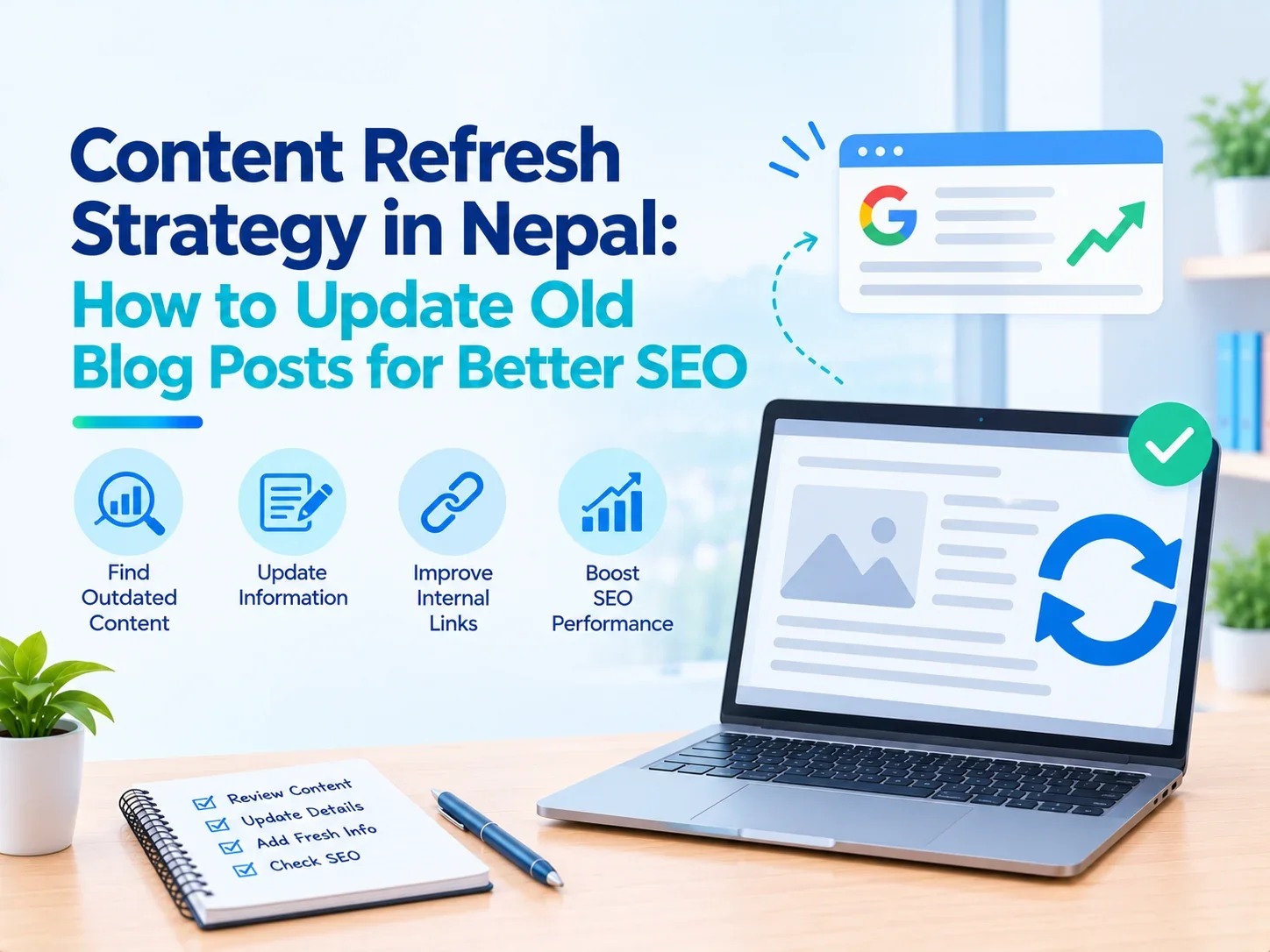
Content Refresh Strategy in Nepal: How to Update Old Blog Posts for Better SEO
Learn how businesses in Nepal can refresh old blog posts, update outdated information, improve internal links, and strengthen organic search performance.
 Kritika Ghimire8 min read
While fresh blog posts are crucial to digital marketing, older ones are not to be overlooked. There can be several dozen posts that can be useful to a business, over time, which either become irrelevant, have decreased in search results, or their content no longer reflects the services offered by the business.
Businesses do not need to constantly create new content, it's possible to enhance the existing content.
A content refresh strategy in Nepal is a process that guides website owners to review their current content, update any outdated information, and improve the content for users.
Refreshing articles that are relevant to the business can be a practical approach to enhance the quality of website for companies investing in SEO without beginning each and every topic from the ground up.
What Is a Content Refresh Strategy?
Content refresh is a process of reviewing an existing page in the web and updating the content that is outdated, incomplete or unhelpful.
This can involve rectifying facts, enhancing explanations, updating screenshots, addressing new customer inquiries, and fixing broken links.
Blog content optimization is different from writing a brand-new article, as it makes use of an existing page.
If the price, technologies, or the expectations of the customers change, for instance, an update to a blog on web development costs in Nepal may be required.
The goal is to maintain an accurate and relevant article, not change the date of publication in order to improve the article.
Why Should Businesses Update Old Blog Posts?
Older content can still be useful, particularly if it addresses questions posed by users that haven't changed.
The examples may be outdated, however, and lack the information and formatting necessary to be useful.
Companies can make sure to update old blog posts for SEO, enhancing readability, precision, and links between correlated pages on their site.
It can also help search engines determine the relevance of the content right now, which can lead to better rankings, but will not always be the case when it comes to refreshing content.
For companies developing a long-term strategy, SEO services in Nepal can support content reviews alongside technical improvements.
1. Identify Blog Posts That Need Attention
Not all articles published need to be changed.
First, review posts that were previously popular but not as many clicks on search are now being given.
It is possible to use Google Search Console to identify changes in impressions, clicks, and search queries.
Other candidates are articles that include obsolete information, broken links or changed services.
The pages that have actionable SEO opportunities should be the first to be focused on for an SEO content audit.
Don't copy or duplicate great articles because they are dated.
A useful and still accurate post might just require some plugs.
2. Review Search Intent Before Editing
Search intent refers to what an individual is trying to achieve when utilizing a search query.
If someone is looking around for “SEO cost in Nepal” then they need pricing details, and if someone is looking for “how SEO works” then they may need an explanation.
Do you still need to edit an article? Be sure to see if it still addresses the question you had in mind.
If a page is dedicated to giving practical advice it should be giving practical advice, not too much of an advert.
Knowing what people want to search for represents an important aspect of content optimization in Nepal.
3. Update Outdated Information
Information changes over time.
An older article may contain incorrect prices, unavailable products, outdated procedures, or references to discontinued services.
Review factual claims and replace information that is no longer accurate. If prices vary significantly, explain the factors affecting costs instead of presenting unsupported figures.
Businesses should also check whether referenced tools, regulations, and external resources remain current.
The goal is to refresh outdated website content while preserving information that is still useful.
Readers should be able to trust the article after its updates.
4. Improve Headings and Readability
A good article can be hard to read if it's poorly organized.
Check the title, introduction, headings and paragraph lengths.
The headings must provide an explanation of what is covered in the subsequent section.
Divide lengthy explanations into shorter paragraphs and eliminate unnecessary repetitions.
In case of any examples, include these with respect to Nepali businesses. Properly formatted text makes it easy to find answers.
But making all kinds of changes in headings just to put more key words in the text can result in awkward text.
Put the emphasis on clarity rather than keywords.
5. Strengthen Internal Linking
Internal links connect related pages within the same website.
For example, an article about improving website content may naturally link to a relevant SEO service page or web development resource.
Internal linking helps visitors discover additional information and allows search engines to understand relationships between pages.
Businesses can connect refreshed articles with relevant web development services in Nepal when discussing website structure or usability.
Use descriptive anchor text and avoid inserting links that do not help the reader.
A few relevant links are generally more useful than numerous unrelated ones.
6. Check External Sources and References
External links should support important explanations or help readers explore authoritative information.
During a content refresh, check whether referenced pages still exist and whether their guidance remains accurate.
Replace broken or outdated references with trustworthy alternatives.
Google's official guidance on creating helpful content explains the importance of useful, reliable, people-first information.
This principle should guide content updates.
A refreshed article should offer genuine value rather than merely appear newer to search engines.
7. Improve Images and Examples
Complicated subjects can be easier to understand when presented in image format.
But the old screenshots or stock picture examples might make an article fall flat.
Change visuals if they are no longer representing the process that is being explained.
Provide informative images with useful alternative text and optimize files.
An article can also benefit from being useful through the use of practical examples.
For example, a digital marketing guide could cover not just traffic but how a local business would measure the enquiries it receives.
The overall reading experience is enhanced by these improvements.
8. Avoid Keyword Cannibalization
If multiple pages on a website have such similar search intent, it can be considered keyword cannibalization.
For instance, if you publish several articles containing the same basic SEO principles, there is no need for this duplication.
When updating an article, read other published material that is relevant to the article.
Determine if each page is for a specific purpose.
In some cases, it may be preferable to integrate overlapping articles together to make a single resource.
To prevent content duplication, businesses planning content marketing strategy in Nepal should have a clear plan for topics.
9. Measure Results After Publishing Updates
Refreshing content should be accompanied by performance monitoring. Take special note of significant measurements prior to alterations.
These can be driven by organic clicks, impressions, relevance of the keyword(s) in the view and enquiries.
Once you have posted updates then check for their performance over a reasonable length of time.
Do not assume that every increase or decrease results directly from the refresh. Competition, seasonal demand, and search changes can also influence traffic.
The objective is to improve organic traffic and content usefulness through informed decisions.
Businesses can connect content performance with wider digital marketing services in Nepal.
How Often Should You Refresh Blog Content?
There is no set time schedule.
Articles about prices, tools or the changing practice of an industry may need to be reviewed on a regular basis.
The content of education that is evergreen can be accurate for much longer.
Businesses can have a quarterly content audit to decide on priorities without spending more time replaying every article.
Focus on meaningful improvements rather than arbitrary publishing dates.
Common Content Refresh Mistakes
One mistake is changing the publication date without updating the article.
Another is removing useful sections simply to shorten the content.
Businesses should also avoid deleting established URLs without considering redirects and existing links.
Keyword stuffing, unnecessary rewriting, and unsupported claims can reduce content quality.
A successful refresh should make the page more accurate, complete, and helpful.
Conclusion
A Content Refresh Strategy in Nepal enables businesses to preserve the worth of their current website material.
Companies can improve older articles by analyzing search intent, updating the facts, making them more readable, checking the links and measuring their performance.
It's okay if you don't need to rewrite the entire blog post.
Occasionally, a few well-selected enhancements offer increased reader satisfaction and serve longer-term SEO purposes.
Frequently Asked Questions
Does updating old blog posts improve rankings?
It can help improve search performance if the updates are truly adding value to the content, but not for ranking purposes.
How often should businesses update blogs?
Look for articles that need to be reviewed periodically and focus on articles that have obvious performance issues or have information that is outdated.
Should businesses change the URL when refreshing content?
The rule of thumb is that it's better to keep the same URL unless there's a compelling reason to change it.
Is refreshing content better than publishing new blogs?
Both are useful. Update old articles if they need it or if they cover new subjects, create new articles accordingly.

Written by
Kritika Ghimire
SEO & Digital Marketing Intern
Kritika works on search visibility and the content behind it, and writes about what actually moves a page up the results for a business in Nepal.
More about Kritika