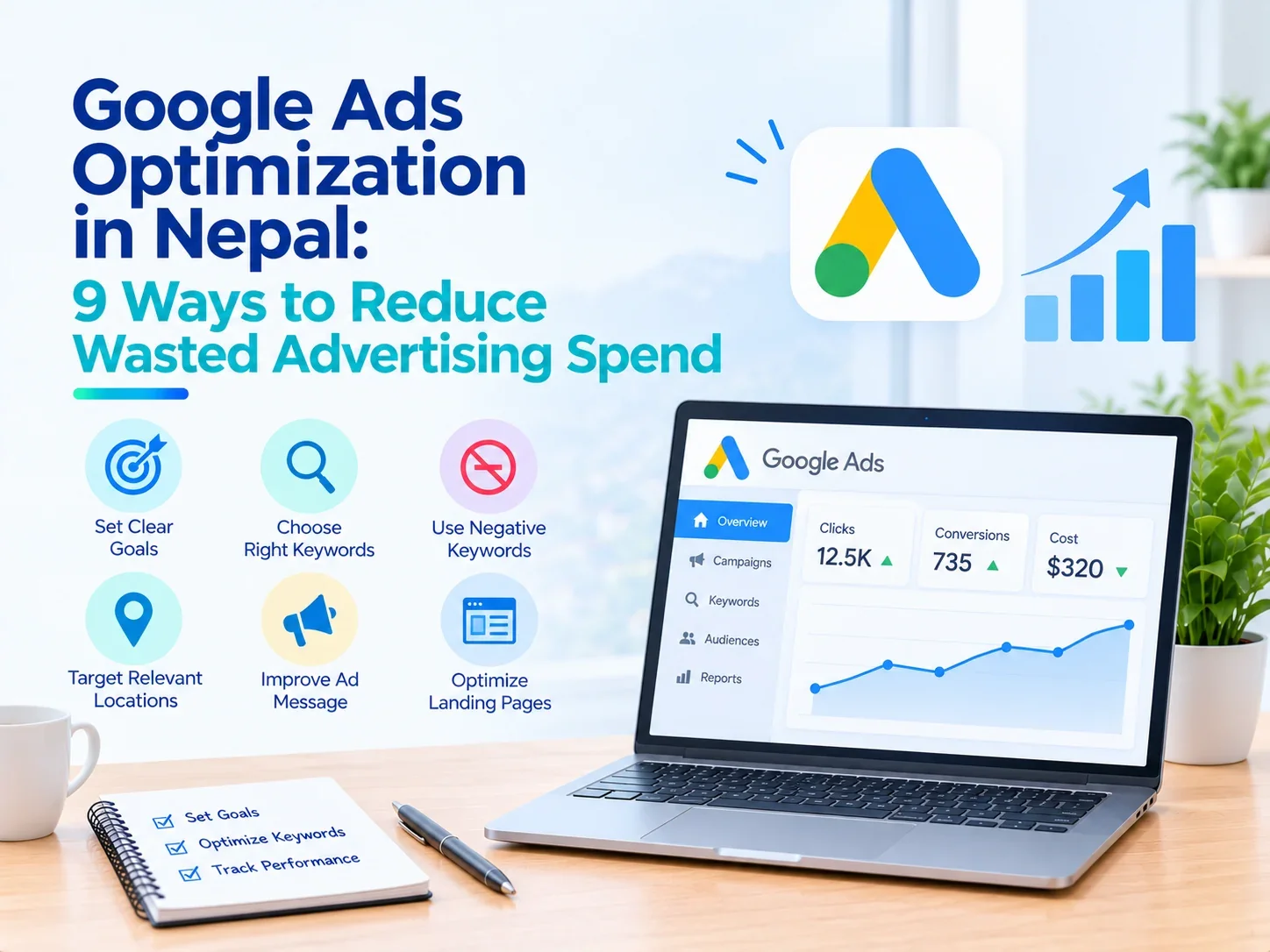
Google Ads Optimization in Nepal: 9 Ways to Reduce Wasted Advertising Spend
Learn how to reduce wasted Google Ads spending in Nepal with better keywords, targeting, landing pages, conversion tracking, and campaign improvements.
 Kritika Ghimire8 min read
When people are looking for products and services, Google Ads can be beneficial to the company to reach those potential customers. But advertising does not necessarily mean enquiries or sales.
Hundreds of clicks into a campaign can lead to no business results. This can occur due to mismatching keywords, too broad of targeting, confusing landing pages, or no conversion tracking.
For companies that are running paid campaigns, Google Ads optimization in Nepal is crucial in order to make the marketing dollars count.
The aim is not just to cut costs. To draw in relevant visitors, drive meaningful actions, and gauge the effectiveness of campaigns for business growth.
In this article, we have shared the 9 practical ways to boost performance of your Google Ads.
What Is Google Ads Optimization?
Google Ads optimization entails analyzing and enhancing ads to meet their goals and performance.
This can involve modifying keywords, targeting settings, ads, bidding strategies, landing pages, and conversion metrics.
Google Ads campaign optimization can help businesses determine how they're spending money and if they get valuable results from their ads spending.
For instance, a building contractor can obtain numerous clicks from individuals seeking building jobs instead of building solutions.
The ad will draw people, but it may not be the people who are potential customers.
Optimization can minimize mismatches.
1. Define a Clear Advertising Goal
In preparing for a campaign, get a clear idea of what success would entail.
Some companies would like visitors to call them; others might require appointment booking or request a quotation or online purchases.
It's important to analyze a brand awareness-centric campaign versus one focused on enquiries.
When it comes to PPC advertising in Nepal, clarity of objectives allows you to decide on keywords, landing pages, and metrics.
Don't only assume that your success is determined by traffic to your website.
A smaller campaign that brings in qualified enquiries, can provide more business value than a larger campaign that brings in irrelevant visitors.
2. Choose Keywords Based on Customer Intent
Not all of the searches about your industry are buying signals.
A user typing “what is interior design” is probably interested in learning more about the field, whereas a user typing “office interior design company Kathmandu” is probably interested in a service provider.
Both searches are useful, but there is a difference in commercial use.
It is important for businesses to prioritize keywords that align with their services and campaign goals.
Pay attention to the choices when selecting a match type for a keyword as they can have an impact on which searches could show ads.
Good keyword selection helps reduce Google Ads costs associated with visitors who are unlikely to become customers.
3. Use Negative Keywords
Negative keywords help prevent advertisements from appearing for certain unwanted searches.
For example, a company selling office furniture may want to exclude searches related to free furniture, job vacancies, or unrelated tutorials.
Using negative keywords in Google Ads can improve traffic relevance and reduce unnecessary clicks. However, exclusions should be selected carefully.
Blocking broad terms without reviewing their meaning could also prevent advertisements from appearing for valuable searches.
Regularly review available search-term reports and identify patterns that do not match your business objectives.
This process should continue after campaigns launch.
4. Target Relevant Locations
For businesses that target specific areas, it is crucial to use location targeting.
If the business is not based in Kathmandu Valley, it might not be worthwhile for them to invest in consulting with places that they can't reach.
Check campaign location settings, and decide if you want to target people who are physically in your service area or people who have been interested in your service area.
These settings can generate various audiences.
The service coverage, service capabilities, and customer demand are also important factors to consider for Google Ads in Nepal.
It might be appropriate to do a nationwide campaign for an online service, but not for a local repair company.
The right choice will be based on the location where the actual customers can get the advertised service.
5. Improve Your Advertisement Message
An advertisement should tell what the business provides and the reasons why it is applicable to the search.
Use generic headlines that grab attention but don't give the service a clear message.
For instance, “Professional Services Available” doesn't help much as a headline as compared to one describing a particular service and location.
All advertisements should be appropriate to the customer's need and connect to a page that conveys a similar message.
Don't make false promises, false discounts or unrealistic claims.
It is important to have clear messaging to direct visitors as to whether the offer is relevant to them before clicking.
Businesses can explore digital marketing services in Nepal for support connecting campaign messaging with business objectives.
6. Send Visitors to the Right Landing Page
One common advertising mistake is sending every visitor to the homepage.
If someone searches for a particular service, they should reach a page that explains that service.
An effective Google Ads landing page should include a relevant headline, useful service information, clear contact options, and a straightforward next step.
For example, a company advertising commercial cleaning should direct visitors to a commercial cleaning page rather than an unrelated general page.
Mobile usability and page speed also matter.
Businesses considering landing page improvements can review web development services in Nepal.
A well-matched landing page can help turn relevant advertising traffic into meaningful enquiries.
7. Set Up Conversion Tracking
Without reliable conversion measurement, businesses may struggle to understand which advertisements generate results.
Google Ads conversion tracking can measure valuable actions such as form submissions, purchases, and certain phone interactions, depending on the available setup.
Choose conversions that reflect actual business goals.
For example, a service company might track successful quotation requests rather than every click on its contact page.
Google's official conversion tracking documentation explains how conversion measurement helps advertisers evaluate campaign performance.
Tracking should be configured accurately and in accordance with applicable privacy requirements.
8. Review Costs and Lead Quality
The Google Ads cost in Nepal is influenced by how competitive the keywords are, targeting, bidding, industry and more.
Unless you're in the same niche as the person who posted this, there is no universal cost per click for every business.
Don't just consider cost per click, but cost per qualified enquiry and customer acquisition cost (CAC) if possible.
In the above scenario, a campaign that spends NPR 10,000 and receives 10 enquiries, would be an average of NPR 1,000 per enquiry.
But when the business understands how many enquiries were relevant to the product and how many turned into customers, it takes on a deeper significance.
Businesses can use SEO services in Nepal alongside paid advertising to build longer-term organic visibility. SEO and Google Ads serve different purposes and can complement each other.
9. Improve Campaigns Using Real Data
Google Ads campaigns should be monitored and not locked after launching.
Track the keywords, conversion rates, location results, ad relevance, and landing page behavior.
Don't make significant changes in just a few clicks.
Campaigns require adequate information to make meaningful conclusions.
Make gradual changes to the tests and record the changes.
For businesses managing several marketing channels, digital marketing support in Kathmandu can help connect advertising performance with enquiries and follow-up processes.
Common Google Ads Mistakes to Avoid
Companies spend their advertising dollars and effort on audience that is too general, fail to incorporate negative keywords, or are advertising services that don't have proper landing pages.
The other error is measuring clicks as success.
If the follow-up is not adequate, there is also the possibility of decreasing the value of the campaign. No matter how well an ad is written, it will not sell if it is not followed up on.
It is important to coordinate between a customer's experience of a website and the campaign ad.
Conclusion
Google Ads optimization in Nepal enables businesses to make informed decisions regarding their investment in Google Ads.
Effective keywords, negative keyword management, correct targeting, helpful landing pages and reliable conversion tracking can help to save money.
Businesses must come down to the level of attracting prospective customers and not just clicks.
Paying for ads can be a more quantifiable component of digital marketing when campaigns are monitored regularly to enhance performance with useful data.
Frequently Asked Questions
How can businesses reduce wasted Google Ads spending?
They can go through search terms, add back relevant negative terms and optimize location targeting as well as direct traffic to relevant landing pages.
How much does Google Ads cost in Nepal?
The google ads costs will depend on the industry, competition, keywords, bidding strategy and targeting. The approach to budget planning should be based on objectives and the value customers can be expected to bring to the business.
Are negative keywords important in Google Ads?
Yes. They are helpful in reducing the number of irrelevant queries that can be seen as excluding the value search but can be carefully excluded to ensure that valuable traffic is not excluded from the site.
Is Google Ads better than SEO?
There is no easy answer about which is better. Google Ads gives you paid visibility, and SEO provides organic search visibility. Many businesses are able to use both in a strategic fashion.

Written by
Kritika Ghimire
SEO & Digital Marketing Intern
Kritika works on search visibility and the content behind it, and writes about what actually moves a page up the results for a business in Nepal.
More about Kritika