ERP Software in Nepal: What It Is, Who Needs It and How to Choose the Right System
Learn what ERP software in Nepal does, which businesses need it, key ERP modules, implementation costs and how to choose the right system.
 Kritika Ghimire8 min read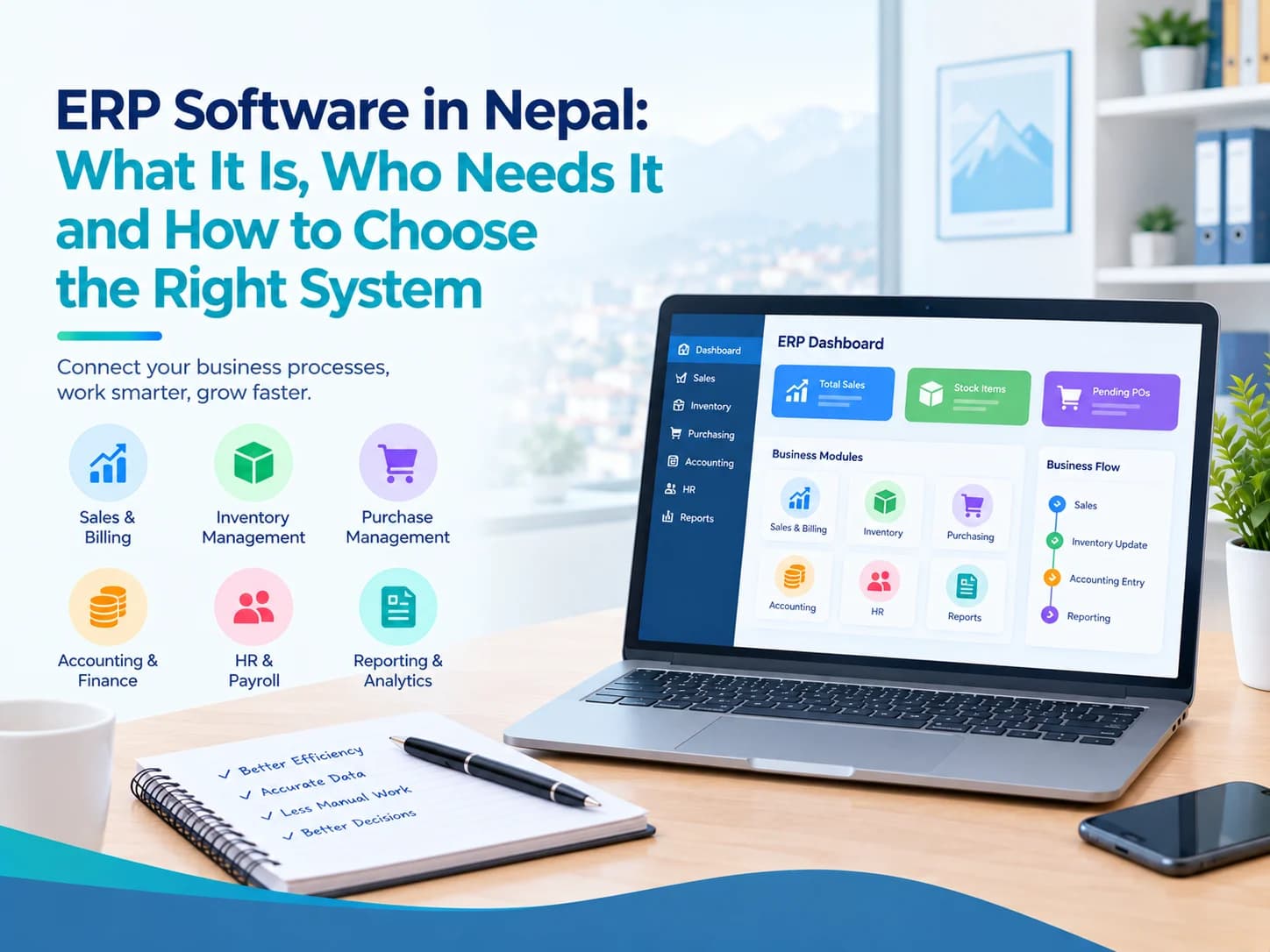
What Is ERP Software in Nepal?
As a company expands, the task of managing the sales, inventories, purchasing, accounting, staffing, and reporting using separate spreadsheet software and applications becomes challenging.
This is where ERP software in Nepal comes to use.
ERP is an abbreviation for Enterprise Resource Planning. This is a business management software that unites different business processes through data and processes integration.
For instance, a sales transaction not only creates record but updates inventory and reporting. Instead of having employees enter data into different systems, departments will have integrated data.
In other words, a properly designed ERP in Nepal will assist companies to avoid duplicates, increase transparency, and streamline operations.
Nonetheless, ERP does not mean purchasing the biggest software solution available on the market. An appropriate ERP system is based on the needs, size, processes, and user base of a particular business.
ERP is part of a broader approach to integrating business processes and information systems. The National Institute of Standards and Technology (NIST) provides resources on information systems and technology standards that can help businesses understand structured approaches to managing digital systems.
Businesses looking for a practical ERP software in Nepal can consider a system that connects sales, inventory, purchasing, accounts, HR, and reporting according to their actual workflow.
Why Do Businesses Need ERP Software?
Often small and growing businesses use Excel, accounting software, notepads, email, and messengers.
All of this software may be effective separately. However, problems arise when business operations become more complicated.
For example, a company may have:
- Sales information in one system
- Inventory records in spreadsheets
- Purchase information somewhere else
- Accounts handled separately
- Employee information in another file
- Management reports prepared manually
This creates a common problem: the information does not match.
A manager may need to ask several employees before finding out how much stock is available, which payments are pending, or how much the business sold during a particular period.
ERP software Nepal businesses use can bring these activities into a connected system.
What Does an ERP System Manage?
The exact features depend on the business, but most ERP solutions are built around several important areas.
1. Sales and Billing
An ERP system can record sales, invoices, customers, payments, and related transactions.
This gives managers a clearer view of sales performance without collecting information manually from different employees.
2. Inventory Management
Inventory is one of the most important areas for businesses that purchase, store, and sell physical products.
ERP software can help track:
- Current stock
- Purchases
- Stock transfers
- Suppliers
- Low-stock items
- Stock valuation
- Multiple locations
When sales and inventory are connected, businesses can reduce the need for repeated data entry.
3. Purchase Management
It becomes easier to track purchases once supplier details, purchase data and inventory data are linked together.
Firms will be able to find out what has been bought, who, at what price and the impact on the inventory.
4. Accounting and Financial Information
ERP software is capable of linking operational data with financial data.
Depending on the way the ERP system is implemented, firms may be able to handle invoices, payments, expenses, accounts and financial reporting through different modules.
It will help reduce the manual reconciliation that may be required between different departments.
5. Human Resources
Large ERP systems may even have modules related to attendance of employees, employee records, payroll and other HR modules.
Not all ERP modules are necessary from the very beginning. ERP modules can be implemented by prioritizing the needs of a firm.
Who Needs ERP Software in Nepal?
ERP is not just for large firms.
Even smaller firms may require ERP when they start finding it difficult to manage operations through different systems.
An ERP software for small business in Nepal may be useful when the company has:
- Multiple departments
- Growing inventory
- Several sales employees
- Multiple branches
- Increasing numbers of customers
- Frequent purchase transactions
- Complicated reporting requirements
- Repeated manual data entry
For a very small business with simple operations, a complete ERP system may be unnecessary.
The important question is not simply, “Do we need ERP?”
A better question is:
“Are our current systems making it difficult to manage the business?”
Cloud ERP vs Traditional ERP
There might be a number of different ways to deploy ERP solution in Nepal.
Cloud ERP
If a business chooses cloud ERP, then the software along with data are kept on the server accessed via the Internet.
This way might make accessing the system from any place easier while reducing the necessity to maintain server infrastructure inside the organization.
Cloud systems might be particularly helpful for organizations which have several branches or people working remotely.
On-Premise ERP
In case of an on-premise solution, the software along with the data will be deployed inside the infrastructure of the organization.
This approach can bring more control over the environment while requiring additional spending on server, maintenance, security, backup and other aspects.
The decision should be based on the requirements and possibilities of the organization.
Custom ERP or Ready-Made ERP?
The one of the most important decisions is related to using the ready-made software or developing a custom ERP software in Nepal.
If your business has workflows that cannot be handled effectively by ready-made software, custom software development in Nepal can provide a more flexible approach.
Ready-Made ERP
It might be appropriate to choose ready-made software in case the business processes coincide with those of the system.
The pros of such a solution might include fast implementation and well-developed features.
However, in order to use such a solution, the business will have to modify certain processes.
Custom ERP
The custom ERP development might be more appropriate if the organization has unique processes, approval workflow, reporting, integrations, or other requirements.
This way allows building a solution that reflects the actual work of the organization without forcing employees to adjust to the software.
The cons is that the development usually takes more time and efforts.
How Much Does ERP Software Cost in Nepal?
There is no single price for ERP software in Nepal.
The cost can vary significantly depending on:
- Number of modules
- Number of users
- Number of branches
- Customization requirements
- Integrations
- Data migration
- Hosting or infrastructure
- Training
- Support and maintenance
Current Nepal market examples show a wide range of ERP pricing, from relatively low-cost subscription products to customized systems costing several lakhs or more.
For this reason, businesses should avoid choosing an ERP simply because it has the lowest initial price.
Instead, compare the total cost of ownership and the actual business problems the system will solve.
What Should You Check Before Choosing an ERP?
Before selecting an ERP system, businesses should look beyond the feature list.
Consider these questions:
Does it match your workflow?
The software should support how your team actually works.
Can it grow with your business?
You may start with sales and inventory but eventually need additional modules.
Does it provide useful reporting?
Managers should be able to access important information without manually preparing every report.
Can it integrate with other systems?
Check whether the ERP can connect with existing accounting, payment, inventory, or other business systems when required.
Is implementation practical?
Even good software can fail if employees do not understand how to use it.
Training, data migration, testing, and phased implementation should therefore be part of the plan.
Businesses that need to manage individual processes, approvals, tasks, and responsibilities may also benefit from workflow management software in Nepal.
ERP Implementation in Nepal: Start with the Right Modules
A common mistake is trying to implement everything at once.
A better approach is to identify the areas creating the most operational problems.
For example:
Phase 1: Sales + Inventory
Phase 2: Purchases + Suppliers
Phase 3: Accounts + Reporting
Phase 4: HR + Additional workflows
This phased approach allows employees to become comfortable with the system before additional modules are introduced.
It also allows management to measure whether the ERP is actually improving operations.
Conclusion
ERP can be helpful if a company has grown beyond the point of using spreadsheet software, applications, and manual processes.
ERP can link up sales, inventories, purchasing, accounts, HR, and reporting processes such that workers have access to information that is consistent.
However, ERP should not be used just because it is fashionable.
Instead, it is the needs of the business that should dictate whether ERP is needed or not.
Sometimes a business management system could suffice while in other instances a full-scale implementation of ERP would be more appropriate.
The aim is to clarify and integrate business processes through technological means. For businesses that do not need a full ERP system, business automation software in Nepal can be another option for improving specific workflows such as leads, sales, service requests, tasks, approvals, and reporting.
Frequently Asked Questions
Is ERP software suitable for small businesses in Nepal?
Yes. Small businesses can use a focused ERP implementation when separate tools and manual processes are becoming difficult to manage.
How much does ERP software cost in Nepal?
There is no fixed cost. Cost will depend on the modules, number of users, customization, integration, and support requirements.
Should I choose cloud ERP or on-premise ERP?
It depends on your infrastructure, access requirements, budget, security needs, and business operations.
Can ERP software be customized?
Yes. It is possible to customize ERP for particular workflows, reports, and integrations where ready-to-use ERP does not fit well.

Written by
Kritika Ghimire
SEO & Digital Marketing Intern
Kritika works on search visibility and the content behind it, and writes about what actually moves a page up the results for a business in Nepal.
More about Kritika