CRM Software in Nepal: Features, Benefits and How to Choose the Right System
Learn how CRM software in Nepal helps businesses manage leads, customers, follow-ups, sales pipelines, reporting and daily sales activities.
 Kritika Ghimire9 min read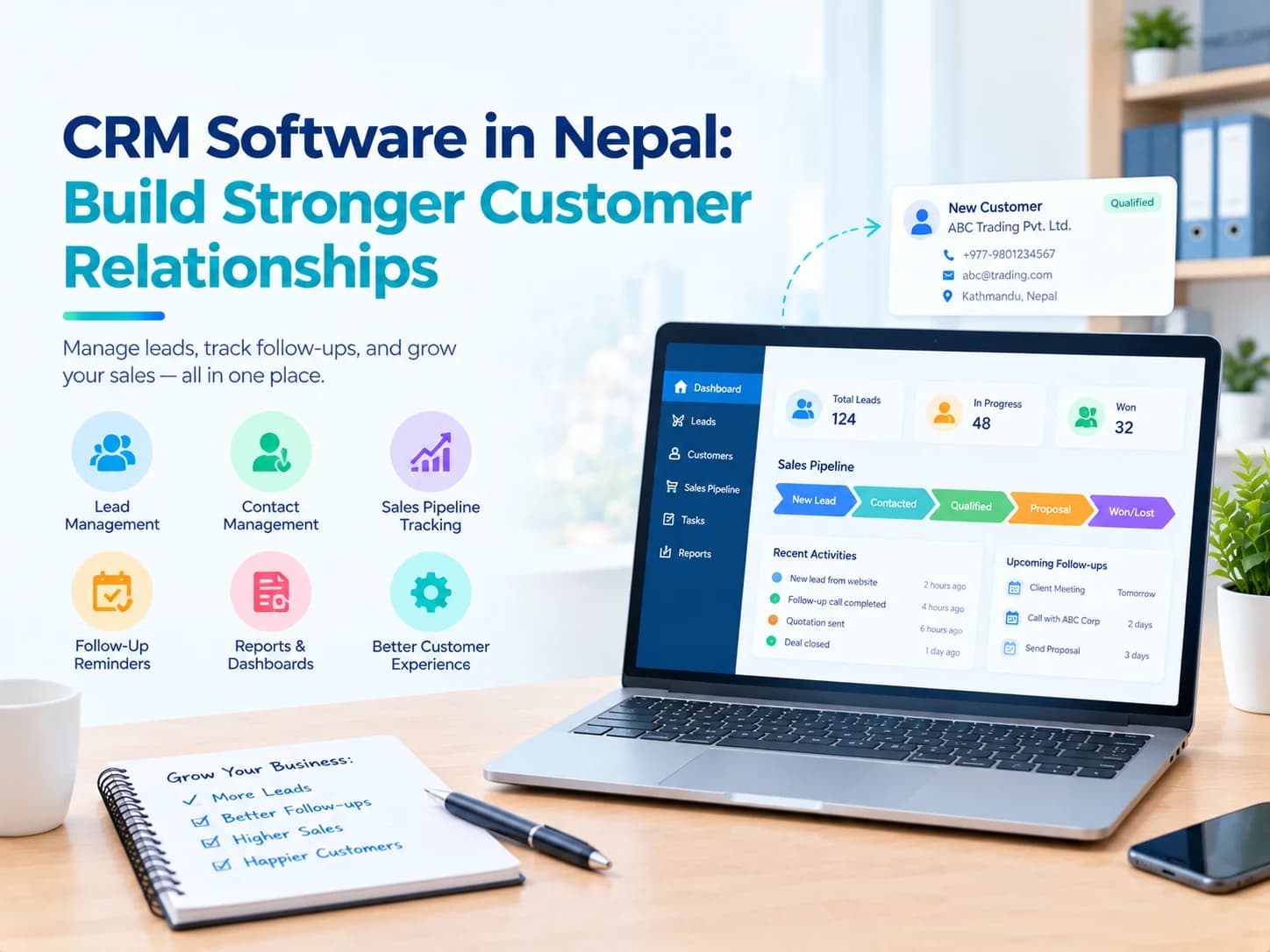
It becomes challenging to manage clients with the growth of the business. The few customers can be managed with phone contacts and Excel sheets; however, hundreds of leads, enquiries, follow-ups, quotations and interactions with customers can be done better by using some kind of organization.
That is where the CRM software in Nepal can become useful for managing customer data and sales processes.
CRM stands for the Customer Relationship Management system that helps businesses to manage their leads, contacts, follow-ups, opportunities and customer interactions. It allows to gather the necessary information about the customers that otherwise would be stored in notebooks, Excel files, notes in phone book and chats in various applications.
For businesses in Nepal, the proper CRM can help to manage follow-ups, improve visibility for sales team members and help to track where the potential customer is in the sales process.
What Is CRM Software?
The CRM software is a system that helps businesses to manage relationships and communications with the customers and potential customers.
While simple customer databases may contain only names and phone numbers, the CRM system contains not only the customer information, but also leads, sales process, follow-ups, tasks, communication history and reporting features.
For instance, when the customer makes an enquiry on a website, on Facebook, by phone call or referral, the business records the data as a lead. Then the lead is assigned to a sales representative and moves through the sales process until becoming a customer.
In this way, the customer relationship management software that Nepal businesses use becomes a single system for managing customer-related processes.
Why Do Businesses in Nepal Need CRM Software?
Many companies still manage customer information with Excel files, notebooks, phone contacts, email and messaging applications.
It can be efficient for a few customers, but the issues arise with growing sales team.
Common problems include:
- Leads being forgotten
- Missed follow-ups
- Duplicate customer information
- No clear responsibility for a lead
- Difficulty knowing the current sales pipeline
- Managers depending on individual salespeople for updates
- Customer information being scattered across different platforms
- Time-consuming manual sales reports
A CRM system in Nepal can bring these activities together so businesses can see what is happening with their leads and customers.
Key Features of CRM Software in Nepal
Different CRM systems offer different features. Businesses should focus on the functions that match their actual sales process.
1. Lead Management
Lead management is among the most critical functions of a CRM system.
A CRM system is capable of storing customer data and assisting in keeping track of where the particular lead was sourced from, who owns it and how to proceed.
The company could have received the leads via its websites, social media, referrals, calls and advertisements. Rather than storing such leads in different locations, it becomes easy for the sales team to manage them using a single system.
The lead management software used by Nepal companies is thus very helpful for a large number of leads. Businesses that mainly need lead tracking and follow-up management can also explore LeadRack, a focused InfoBytes product for managing leads, stages, owners, and next steps.
2. Customer and Contact Management
A CRM can keep customer information in an organized format.
Depending on the system, businesses can maintain details such as:
- Customer name
- Contact information
- Company
- Previous interactions
- Assigned salesperson
- Sales history
- Follow-up activities
- Notes and tasks
Having this information in one place allows employees to understand the customer before starting the next conversation.
3. Sales Pipeline Management
A sales pipeline shows where leads are in the sales process.
For example, a business may use stages such as:
New Lead → Contacted → Qualified → Proposal → Negotiation → Won/Lost
A CRM allows sales teams to move leads through these stages and gives managers a clearer view of the overall pipeline.
This is one of the main advantages of sales CRM software Nepal businesses can use to organize their sales activities.
4. Follow-Up Reminders
A lead can be valuable today and forgotten tomorrow if nobody follows up. CRM systems can help salespeople remember calls, meetings, quotations, and other follow-up activities.
Instead of depending entirely on memory or separate calendar notes, sales teams can have tasks and reminders connected to customer records.
This can reduce the chances of warm leads becoming cold simply because a follow-up was missed.
5. Sales Reports and Dashboards
Managers need to understand more than the number of leads received.
They may want to know:
- How many leads are currently active
- Which salesperson handles each lead
- How many leads became customers
- Which sources generate the most leads
- How many opportunities are at each sales stage
- Which follow-ups are pending
CRM dashboards and reports can turn these records into information that managers can use when making business decisions.
6. Lead Source Tracking
Businesses may receive customers through different channels.
A CRM can help identify whether leads are coming from:
- Website enquiries
- Referrals
- Phone calls
- Events
- Other marketing activities
This helps businesses understand which channels are generating potential customers.
What Are the Benefits of CRM Software?
The primary benefit of using CRM software is the better way to manage the customer relationships of businesses.
Better Lead Follow Up Management
Sales people can identify leads that need follow up actions.
Reduced Missed Opportunities
Since leads are assigned, monitored and followed up using one system, businesses can minimize the chance of enquiries going unattended.
Improved Sales Tracking
Sales managers can track the entire sales funnel without requiring individual reports from salespeople.
Centralized Customer Information
Customer information including activities and follow ups can all be stored in one place instead of several tools.
Improved Team Accountability
With each lead assigned to a person and a task, it is easier to determine who is accountable for taking the lead further.
Improved Sales Reporting
Rather than making reports manually using several spreadsheets, businesses can analyze sales using CRM data.
CRM Software for Small Businesses in Nepal
CRM software is not meant exclusively for large firms.
A CRM software for small business in Nepal that a company selects can assist a small sales department in organizing client data and follow-ups without adding unneeded complexity.
A small consultancy firm, educational firm, real estate firm, software firm, trading firm, or any other kind of service firm may employ just a few sales staff yet process lots of inquiries.
In such a business, some key aspects will include lead management, client database, reminders for follow-up, sales stages, and reports.
It is not necessary for a small business to choose the CRM software with the most features. It needs to select the software that an employee can utilize regularly.
CRM Automation Nepal Businesses Can Use
CRM automation can reduce repetitive sales tasks.
For businesses that want to automate more than customer and sales activities, business automation software in Nepal can also help organize lead tracking, follow-ups, tasks, service requests, and reporting.
For example, a business may automate or structure activities such as:
- Assigning new leads
- Creating follow-up tasks
- Sending reminders
- Updating lead stages
- Tracking customer activities
- Generating sales reports
This does not mean every sales activity should be automated. Human communication remains important, particularly when customers need consultation or personalized support.
The goal of CRM automation Nepal businesses adopt should be to reduce repetitive administrative work so sales teams can spend more time communicating with customers.
CRM Software vs Spreadsheets
Spreadsheets are highly efficient tools in many spheres of activity of a company especially when there are few employees.
Nevertheless, spreadsheets may get out of control when several employees start adding and modifying information about clients.
A spreadsheet can list all the leads, but it does not necessarily offer the same workflow with regards to lead ownership, follow-up, sales stages, reminders, and reports.
CRM software is tailored to the management of customers and sales. It can tie up those activities and provide access to information for different employees.
It is not necessary for a company to stop using spreadsheets right away. When client data is becoming hard to manage, it makes sense to consider switching to CRM.
How to Choose the Right CRM Solution in Nepal
Choosing a CRM solution in Nepal should start with understanding your current sales process.
Before selecting software, consider the following factors: Identify Your Sales Process
Understand how a lead moves from the first enquiry to a completed sale. Your CRM should support this process rather than forcing your team into an unrelated workflow.
Check Lead and Customer Management
Make sure the system can store the customer information your business actually needs.
Review Follow-Up Features
Look for tasks, reminders, ownership, and activity tracking if follow-up management is a major challenge.
Check Reporting
Managers should be able to understand pipeline activity, sales performance, and lead sources without depending entirely on manually prepared reports.
Consider Ease of Use
A CRM with hundreds of features is not useful if employees find it too complicated to use.
Consider Future Growth
Your CRM should be able to support your business as the number of customers, salespeople, and leads increases.
If your workflow requires features beyond a standard CRM, custom software development in Nepal can be considered to build a system around your specific business processes.
Conclusion
The CRM software does not only work like an online address book. It has the potential to be the core platform for handling leads, customers, sales, follow-ups, and reporting. For enterprises in Nepal who currently make use of spreadsheets, notebooks, mobile contacts, and other disorganized messages, the CRM software in Nepal offers a better way to manage their customers.
The appropriate CRM system needs to be compatible with the way your company sells. It needs to help your workers easily handle leads, keep them updated about follow-ups, and let you know what your sales look like.
As a business expands, the importance of an organized customer database becomes very vital. The proper CRM system will save your business time and let you focus on relationship building.
Frequently Asked Questions
Who should use CRM software?
CRM software will be helpful for businesses that deal with leads, enquires, customers, sales opportunities, and follow-ups regularly. This may include consultancy firms, trading firms, real estate firms, IT firms, education firms, service firms, and many more kinds of businesses.
Is CRM software useful for small businesses?
Yes, CRM software is helpful for small businesses to organize customer information, lead management, follow-up, and sales without using spreadsheets and notes completely.
Can CRM software track leads from different sources?
Yes. With the help of different types of CRM software, businesses can easily track leads from their website, social media, referrals, phone calls, marketing campaigns, and many more sources.
Can CRM software automate follow-ups?
CRM systems can help to automate follow-up using such features as reminders, tasks, alerts, and workflow. It all depends on the CRM system.

Written by
Kritika Ghimire
SEO & Digital Marketing Intern
Kritika works on search visibility and the content behind it, and writes about what actually moves a page up the results for a business in Nepal.
More about Kritika