Customer Complaint Management in Nepal: How Businesses Can Respond Faster and Build Trust
Learn how businesses in Nepal can manage customer complaints, improve response times, track service requests, and build customer trust.
 Kritika Ghimire8 min read
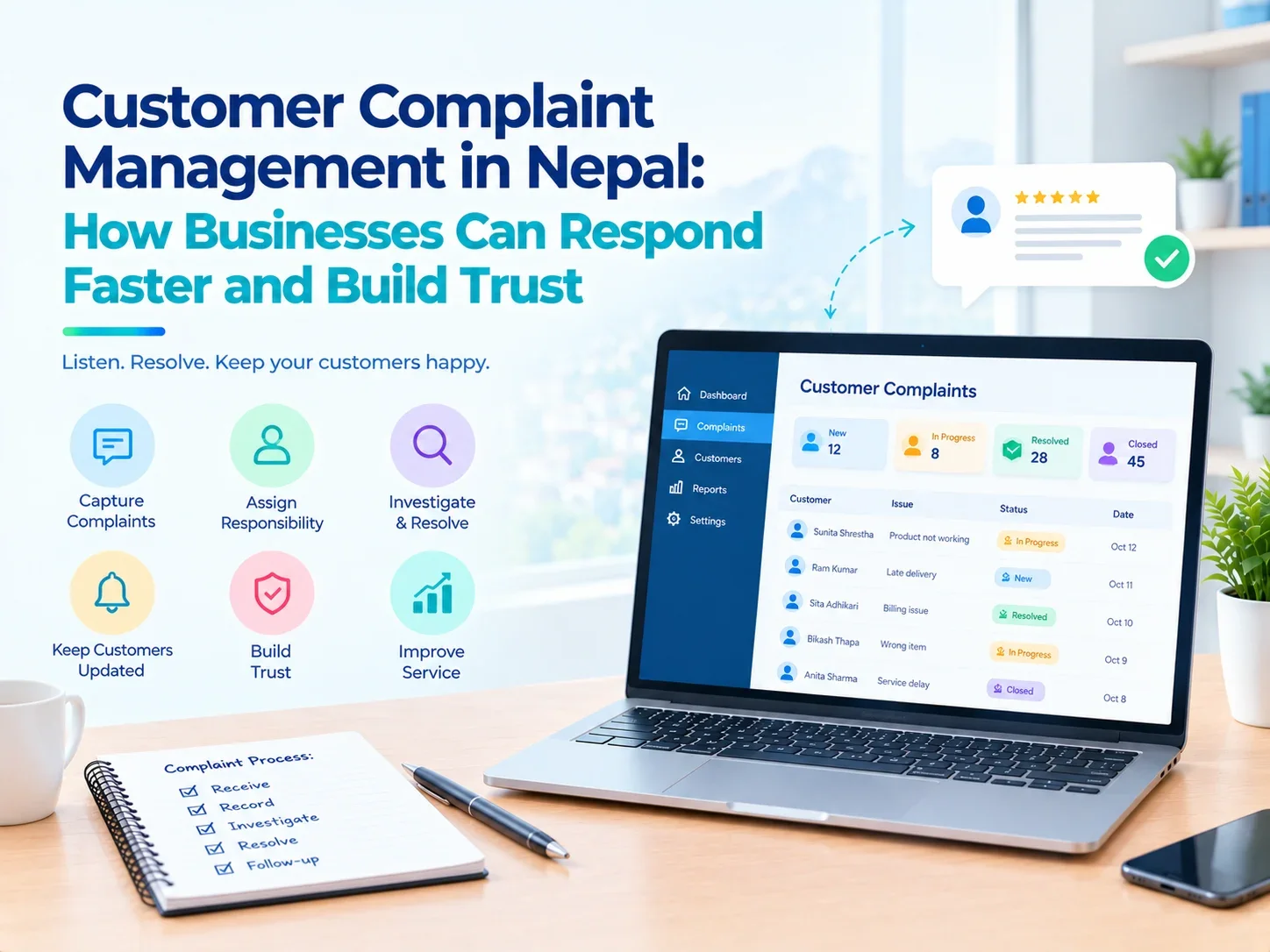
All businesses have to deal with complaints from customers. A delivery may arrive late, a product may not work as expected, or a customer may wait too long for a response.
There's no way to avoid a complaint, but by how a business responds to a complaint, it can either encourage customers to return to see them or drive them away.
Customer complaint management in Nepal is emerging as a crucial aspect of ensuring service reliability, especially for expanding businesses. Whether it's via phone call, Facebook message, email or in person, monitoring all the complaints can be challenging.
By following a structured approach, businesses can ensure that they are responding in a consistent manner, have a chain of command to follow, and will follow-up until issues are addressed.
This guide will explain how businesses can make the complaints procedure more efficient whilst not making the complaints process overly complicated.
What Is Customer Complaint Management?
Customer complaint management involves receiving, recording, investigating, resolving and reviewing complaints from customers.
Does not mean that it is only about saying sorry when it goes wrong. Businesses must be aware of the problem, know who to contact within the business, talk to the customer and verify if the problem has been solved.
Good customer complaint handling establishes a straight-forward procedure that employees can follow.
For instance, if a customer complains about a product, the company should make note of the complaint, check the purchase record, determine the problem and inform the customer about the available options.
A consistent process helps to minimize confusion for customers and employees.
Why Is Complaint Management Important for Nepali Businesses?
Customers expect businesses to respond when problems occur. Ignoring complaints can damage relationships, even when the original issue was relatively small.
Common challenges include:
- Complaints getting lost in messaging applications
- Employees being unsure who should respond
- Customers repeating the same information
- Delayed updates about unresolved issues
- Managers having limited visibility into recurring problems
Improving customer satisfaction in Nepal requires businesses to pay attention to these everyday service experiences.
A clear complaint process can help organizations identify service weaknesses and improve communication.
1. Make It Easy for Customers to Report Problems
Customers should be aware of how they should reach out to a business when things go wrong.
Complaint channels can be provided in the form of a telephone number, via a form on the web or via email, through social media or at a service desk. Not every communication channel is required for businesses.
They require a couple of dependable channels that the employees can check on regularly. Information about contact should be readily available, and the customers should be aware of what information to provide.
A service provider for appliances may ask for the customer's contact information, product information, date of purchase and the description of the problem.
2. Record Every Complaint Properly
One of the frequent issues is that customer problems are only in the personal chat messages or notes.
In the absence of the responsible employee, another team member might not know what has happened.
A good customer complaint tracking system will capture details of the customer, details of the issue, date received, employee assignment, status and resolution.
Businesses handling frequent enquiries can explore business automation solutions in Nepal to organize customer requests, responsibilities, and reporting.
The purpose is to maintain continuity even when several employees participate in resolving an issue.
3. Assign Clear Responsibility
There should be someone accountable for the next step on all complaints.
If they are not the owner the staff member will think that someone else is dealing with the issue.
A simple complaint management process can follow these stages: Complaint Received → Assigned → Under Review → Action Taken → Customer Updated → Closed
The exact stages will depend on the business.
A retail store could require product inspection and product replacement procedures; a service company could require technician assignment and repair verification procedures.
Assigning responsibility makes it easier for people to know what to do to improve.
4. Set Realistic Response Expectations
People tend to get irritated if they are not aware if their complaint has been received or not.
An acknowledgment can help to relieve their concerns about the problem being considered. The concept of reasonable response times should be determined by the urgency of the complaint, staff availability and working hours of the business.
For instance, if someone's service is interrupted urgently, it needs to be dealt with sooner than a general product enquiry. Don't guarantee solutions within a short period if investigation or supplier coordination is required.
Nothing is more valuable than clear communication than unrealistic promises.
5. Keep Customers Updated
Resolving complaints can take time, particularly when several departments or external suppliers are involved.
Customers should not have to contact the business repeatedly for basic updates.
A structured customer support workflow can help employees track pending actions and communicate progress.
For businesses managing multiple requests, workflow management practices can help organize assignments, status changes, and follow-ups.
Even a short update explaining that an issue is still being investigated can improve the customer experience.
6. Use Automation Where It Helps
Not every customer conversation should be automated.
However, repetitive administrative activities can often be simplified.
Customer service automation in Nepal may help businesses acknowledge requests, assign complaints, create reminders, and monitor unresolved cases.
For example, a new complaint submitted through a website form could create a service ticket for the appropriate employee.
A manager could then review pending complaints without manually requesting updates from every team member.
Businesses requiring specialized service workflows can explore custom software development in Nepal.
Automation should support employees rather than prevent customers from reaching a person when necessary.
7. Track Service Requests Until Resolution
There are complaints that need to be investigated in the field and/or technical inspections and/or replacements and/or reappointment.
This is especially significant for repair companies, equipment suppliers and maintenance providers in relation to managing service requests.
Staff to be aware of the work they have carried out, who the customer is and what has not been completed.
InfoBytes Nepal's Serviol field service solution is designed around service tickets, planning, attendance, and job history.
For service businesses, connecting customer complaints with actual service activities can provide better visibility into unresolved work.
8. Learn From Repeated Complaints
After a complaint is resolved, it should not go away from the management agenda right away.
Complaint history can be checked for businesses to see if there are any common problems. If complaints are delivered regularly, for instance, this can be a logistics issue, if there is repetitive faults in the products, then it may be a question of supplier discussions.
Some helpful metrics are how many complaints are filed, how quickly they are acknowledged, how quickly they are resolved, how many complaints are re-opened, and the types of issues most common.
These indicators can support customer service improvement by showing where processes need attention. The international standard ISO 10002 provides guidance on complaint handling within organizations.
Common Mistakes Businesses Should Avoid
One mistake is treating complaints as personal criticism rather than useful information.
The other is not confirming if the customer received the promised action or not when closing cases.
Complaints should not be passed among the employees of the business, forcing the customer to give the same information again.
A good process should be easy enough for employees to follow so that it can be executed consistently and not change when unusual circumstances arise.
How to Start Improving Complaint Management
Begin by reviewing how complaints currently reach your business.
Determine how information is lost, what happens to the information and which issues take the longest to resolve. Then develop a standardized reporting system and designate people to handle each complaint.
Start simple status tracking and review issues that are still pending periodically. As more and more customers complain, take into account whether a connected customer service system will make coordination easier.
The best solution is to first enhance the process and then use technology when it is a solution to an actual problem.
Conclusion
Customer complaint management in Nepal is not just a matter of addressing the issue but about making the customer feel heard and that their complaint is attended to.
There are no complex processes for businesses to start. It is important to have good communication and keep accurate records, along with assigned responsibilities and periodic follow-up meetings.
When operations expand, smart workflows and the right automation can make sure that teams don't miss the important details as they manage more complaints.
The purpose is to close complaints in a quicker timeframe, not just to close them quickly. It's for solving issues correctly, gaining insights from reoccurring issues, and developing customer relationships.
Frequently Asked Questions
Why is complaint tracking important?
Monitoring enables the business to identify responsible staff, to keep an eye on issues that are not yet been resolved and to write down what has been done.
Can small businesses improve complaint management without software?
Yes. A simple and unambiguous complaint record keeping system, a clear point of responsibility, and consistent follow up can help to enhance complaint handling, before dedicated tools are implemented.
Can automation help with customer complaints?
Yes. Acknowledgements, assignments, reminders, tracking of status and reporting can be supported by automation.
How can businesses measure complaint handling performance?
Businesses can measure complaint handling performances by monitoring response times, resolution time, unresolved cases, repeated complaints and customer feedback.

Written by
Kritika Ghimire
SEO & Digital Marketing Intern
Kritika works on search visibility and the content behind it, and writes about what actually moves a page up the results for a business in Nepal.
More about Kritika