Clinic Software Cost in Nepal: What Affects the Price?
Learn what affects clinic software cost in Nepal, from users and modules to customization, support, security, and implementation.
 Kritika Ghimire10 min read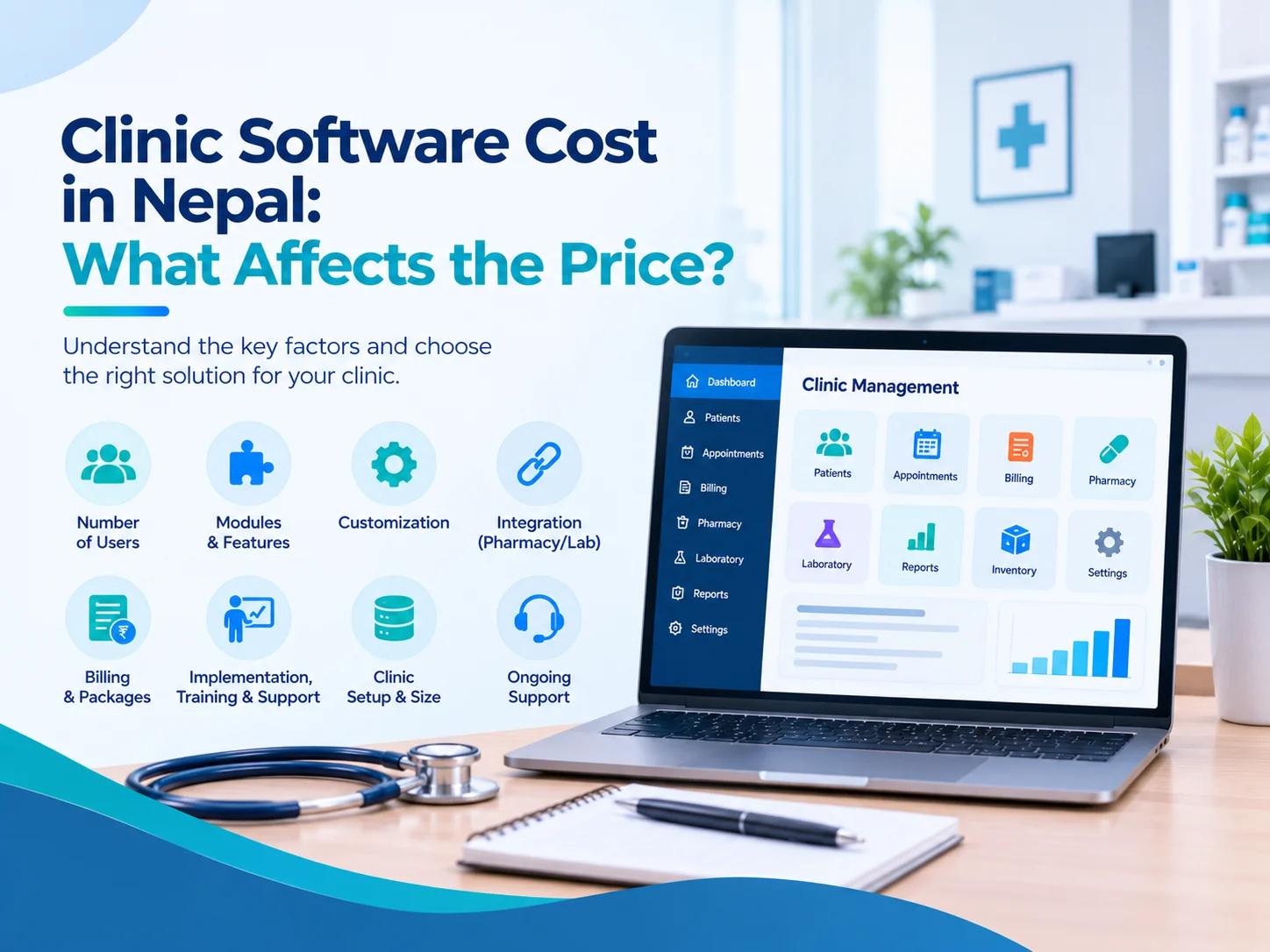
The first question one might ask when planning to digitize the clinic is:
How much does a Clinic software price in Nepal?
It will depend on the needs of your clinic. The organization and appearance of a small clinic with a single counter could be simpler than a polyclinic with multiple doctors, medications, lab coordination, billing, reporting, and multiple staff members.
A real Nepal based example clinicNP by Infobytes Nepal ranges from Rs. 45, 000/- to Rs. 60, 000/- based on the requirement of the clinic and the set up. This should not be considered as a benchmark for all the clinic software providers in Nepal, though.
The pricing models, features, modules and packages vary from provider to provider. Hence, it is crucial to familiarize yourself with what is covered in the price of clinic software in Nepal and what can make it more or less expensive.
What Determines Clinic Software Cost in Nepal?
There are systems available at the clinic management software in Nepal market that all have a wide variety of functions.
There are a few solutions which deal with patient registration and billing primarily, and some which merge patient data, appointments, pharmacy, lab management, doctor management, reports and other functions.
This is why there can be different pricing from two software vendors for the same product.
The primary components of the cost of the main clinic software are the number of users, the modules needed, the customization, the billing, the integration with the Pharma/Lab, the implementation, training, support or deployment.
1. Number of Users and Counters
The number of people using the system can affect the overall cost.
A small clinic may have:
- One reception or billing counter
- One administrator
- A few doctors
A larger medical centre may need separate access for receptionists, accountants, doctors, pharmacy staff, and management.
Some providers charge according to users or counters, while others offer a package covering the overall clinic setup.
When requesting a quotation, ask whether the quoted amount includes all the users and counters your clinic needs.
2. Modules and Features You Need
Another major factor is the scope of the software.
Basic clinic software features may include:
- Patient registration
- Appointment management
- Consultation records
- Billing
- Basic reports
A broader clinic management system Nepal clinics use may also include:
- Pharmacy management
- Laboratory workflow
- Doctor-share calculations
- Inventory
- Financial reports
- User permissions
- Activity logs
- Offline operation
ClinicNP, for example, combines clinic and pharmacy operations and allows modules to be switched on or off depending on the clinic's setup.
Therefore, when comparing clinic management software price, don't compare only the product names or starting prices. Compare the actual modules included in each package.
3. Patient and Appointment Management
A clinic focusing on billing needs will have different requirements than a clinic that is interested in complete patient management.
Patient management software that a clinic uses in Nepal can comprise patient enrollment, lifetime patient ID, visit record, appointments, doctor detail, and duplicate-patient detection.
These functions can also minimize repetitive data entry and help the patient get information they need during their next visit.
If these are important factors for your clinic, include them when you're asking for a quotation.
The big question is not simply: What is the price of the software?
It is: Which of our daily clinic routines does that cover?
4. Billing and Financial Features
Another factor to think about when determining software needs is how it's billed.
Consultation charges may be billed and invoices produced in basic clinic billing software Nepal clinics use. More advanced systems can link consultations, diagnostics, medicines, payments, doctor shares and reports.
For example, ClinicNP facilitates a combined billing process that allows for including consultation, prescription services, diagnostics and medicines in a single bill.
The scope of software may be influenced if your clinic has a pharmacy or diagnostic service, and these are combined in the same billing process.
5. Pharmacy and Laboratory Integration
Not every clinic needs pharmacy or laboratory functionality.
A consultation-focused clinic may need fewer modules than a polyclinic that also:
- Dispenses medicines
- Tracks pharmacy stock
- Manages batch and expiry information
- Coordinates laboratory work
- Tracks doctor shares
- Produces combined bills
- Maintains purchasing records
This is another reason clinic software pricing varies between providers.
ClinicNP, for instance, integrates clinic and pharmacy together, and can have modules turned on or off depending on the setup of the clinic.
So don't compare clinic management software price simply based on the name or the initial pricing. Analyze what is in each package in terms of modules.
If pharmacy operations are an important part of your clinic, you can also compare what pharmacy software in Nepal offers for stock, expiry, purchasing, billing, and dispensing.
6. Customization
Some clinics want software to follow their existing workflow rather than significantly changing how their staff work.
Customization can include:
- Special reports
- Custom invoice formats
- Additional user roles
- Specific fields
- Additional integrations
- Custom business rules
The more customization a clinic requires, the more the implementation cost can potentially increase.
However, customization is not always necessary. If an existing system already covers most of your workflow, a standard setup can be simpler and more cost-effective.
7. Hosting and Deployment
Another factor is where and how the software operates.
Depending on the provider, a clinic may use a cloud-based setup, local installation, or another deployment model.
Before choosing medical software in Nepal clinics can use, ask:
- Where is our data stored?
- Is hosting included?
- Are backups included?
- Who handles updates?
- What happens if the internet stops?
- Can the system work offline?
- Are additional servers or hardware required?
These questions help reveal costs that may not be obvious from the initial quotation. ClinicNP, for example, supports offline billing and registration, which can be relevant for clinics where internet connectivity is not always reliable.
8. Training and Implementation
Buying software is only one part of the process.
Staff may need training on:
- Patient registration
- Appointments
- Billing
- Reports
- Pharmacy workflows
- User permissions
- Daily operations Implementation may also involve setting up doctors, services, rates, users, permissions, invoice formats, fiscal years, and other clinic-specific information.
Therefore, when comparing the clinic software price in Nepal providers quote, ask whether implementation and staff training are included.
A quotation that appears more expensive may include services that another provider charges separately.
9. Support and Maintenance
Support is another factor that should be considered when calculating the long-term cost.
Ask what happens after the software is installed.
For example:
- Is technical support included?
- Are software updates included?
- How are problems handled?
- Is staff training available?
- Are future improvements included?
- Is there a separate maintenance fee?
These questions are particularly important because clinic software becomes part of the daily workflow.
A low initial price does not necessarily mean a low total cost if important services are charged separately later.
10. Security and User Permissions
Clinic software handles sensitive patient and business information, so security should be part of the evaluation.
When comparing systems, ask about:
- User roles
- Password protection
- Access permissions
- Activity logs
- Backups
- Data recovery
- Data access controls
The World Health Organization also highlights areas such as data management, transmission security, monitoring, and user behaviour when discussing cybersecurity and privacy for digital health information systems.
Security features may not always be visible when comparing two software prices, but they can be important when deciding which system is suitable for your clinic.
How Much Does ClinicNP Cost in Nepal?
For clinics specifically considering ClinicNP, the current price range is:
NPR 45,000 to NPR 60,000
The final amount depends on the clinic's requirements and selected setup.
ClinicNP brings several clinic operations into one system, including patient records, visits, appointments, doctors, billing, pharmacy, laboratory workflow, and reports.
The system is designed for clinics, medical centres, polyclinics, and dispensing counters, with different modules available according to the operational requirements.
This makes the NPR 45,000–60,000 range a useful real-world reference when researching clinic software cost in Nepal, but it should not be interpreted as a standard market-wide price.
Other providers may use completely different pricing structures.
To understand how clinic, pharmacy, and laboratory workflows can work together, you can also read our guide to clinic management software in Nepal.
One-Time Cost vs Recurring Cost
When comparing clinic software pricing, look beyond the initial quotation. Software providers may use different models, such as:
- One-time licensing
- Monthly subscription
- Annual subscription
- Per-user pricing
- Per-branch pricing
- Customized project pricing
For example, if a clinic is comparing a NPR 50,000 one-time software package with a subscription-based system, it should calculate the expected cost over several years rather than comparing only the first payment.
Ask whether the following are included:
- Software license
- Installation
- Training
- Updates
- Support
- Hosting
- Backup
- Customization
This gives you a more realistic picture of the total cost.
What Should You Ask Before Buying Clinic Software?
Before selecting a system, prepare a simple checklist.
Ask the provider:
- 1What modules are included?
- 2How many users and counters are included?
- 3Is patient history included?
- 4Are appointments included?
- 5Is billing included?
- 6Can pharmacy operations be integrated?
- 7Can laboratory workflows be managed?
- 8Is customization included?
- 9Is staff training included?
- 10Are backups included?
- 11Is technical support included?
- 12Are software updates included?
- 13Can the system work when the internet is unavailable?
- 14Where is the data stored?
- 15What will the total cost be after one, two, or three years?
These questions make it easier to compare different clinic management software Nepal providers based on actual value rather than just the initial quotation.
Is Cheaper Clinic Software Always Better?
Not necessarily.
A clinic software system becomes part of everyday operations. If staff have difficulty using it, patient information has to be entered repeatedly, reports are difficult to access, or important workflows require separate systems, the initial saving may not provide much practical value.
Instead, compare the price with:
- Features you actually need
- Ease of use
- Implementation
- Training
- Security
- Support
- Reliability
- Scalability
For example, ClinicNP's NPR 45,000–60,000 range should be evaluated alongside what is included in the selected setup rather than viewed as just a software license price.
The goal should be to find a system that fits your clinic's workflow and budget.
How to Compare Clinic Software Prices in Nepal
A simple comparison table can make the decision easier. Below listed are the things that you should consider while comparing the clinic software price in Nepal:
- How much do you pay to start?
- How many staff can access the system?
- Clinic, pharmacy, lab, billing, and reports modules etc
- What changes can be made?
- Is staff training included?
- What support is provided after installation?
- Are future updates included?
- How is clinic data protected?
- Can essential work continue without internet?
- What will you pay over several years?
For example, when evaluating ClinicNP against another system, you can compare the other provider's quotation against the NPR 45,000–60,000 ClinicNP range, while also comparing the actual features and services included.
Conclusion
The clinic software cost in Nepal depends on much more than the software itself. The final cost can be affected by the users, modules, billing requirements, integration with Pharmacy and Lab, customization, deployment, training, support, security, and implementation.
A concrete example of a local reference would be ClinicNP from NPR 45,000 to NPR 60,000 for the various needs and configurations of the clinic. But price is not everything you should consider when making comparisons.
Before buying, ask:
What will I get for this price and how does it fit into my clinic?
This question will help you in a more realistic comparison of clinic software price Nepal options and select the software system according to its cost and usefulness.
Frequently Asked Questions
What affects clinic software pricing?
Key factors are number of users, modules, customization, integration with the pharmacy and lab, deployment, training, support, security and implementation needs.
Does clinic software include pharmacy management?
There are systems that have pharmacy management and some that have only clinic operation management. Always enquire whether the pharmacies have the following functions: medicine sales, medicine stock management, batch and expiry management, and medicines purchasing.
Is clinic management software worth the cost?
This will depend upon the clinic's needs and the software chosen. When a system is effective in managing day-to-day processes like patient registration, appointments, patient records, billing, pharmacy, laboratory processes, and reporting, it can be valuable.

Written by
Kritika Ghimire
SEO & Digital Marketing Intern
Kritika works on search visibility and the content behind it, and writes about what actually moves a page up the results for a business in Nepal.
More about Kritika