Manual vs Automated Business Processes in Nepal: When Should You Make the Switch?
Compare manual vs automated business processes and learn when Nepali businesses should automate tasks, reduce errors, and improve daily operations.
 Kritika Ghimire8 min read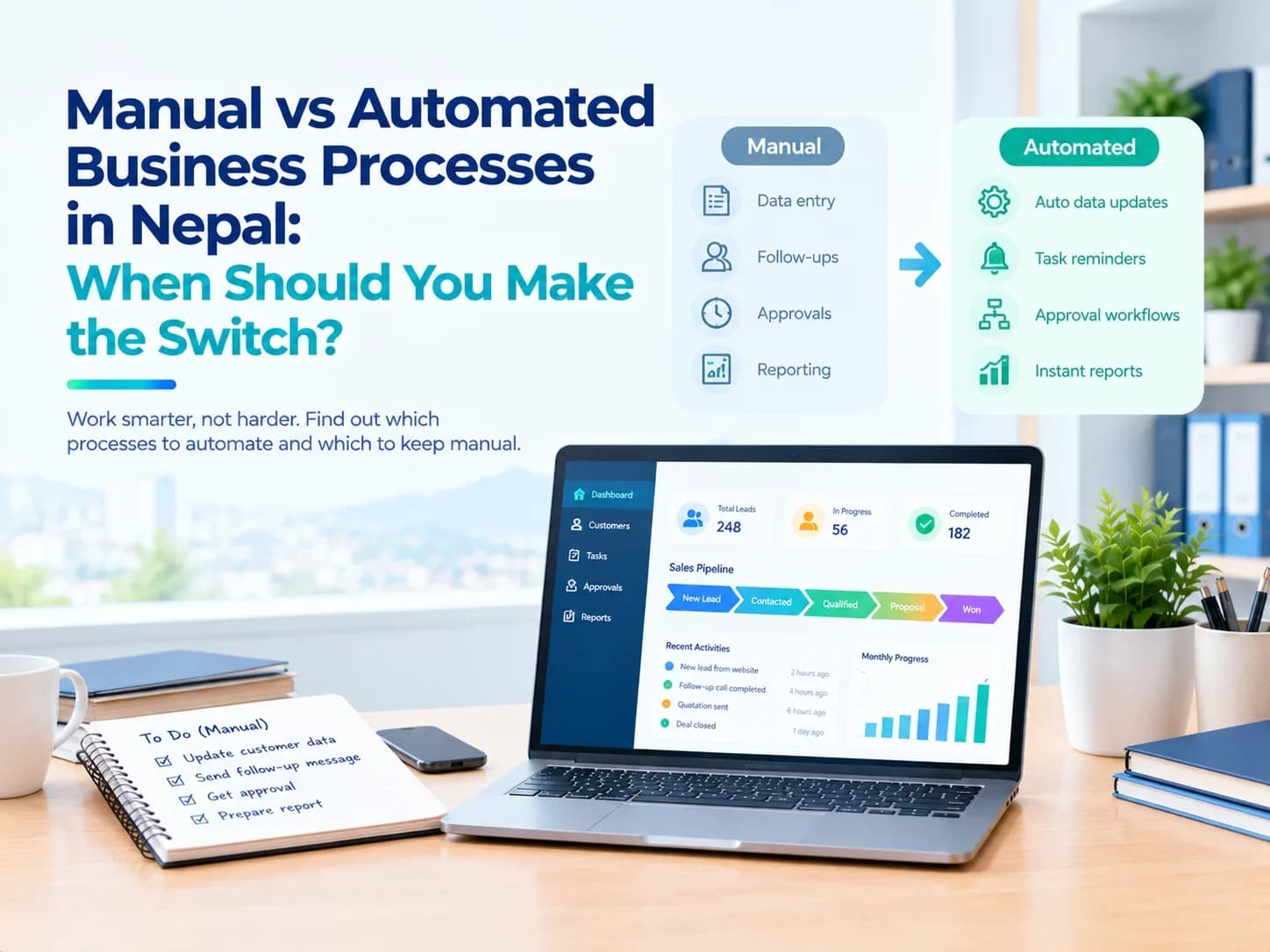
There are tasks that all businesses need to perform each day to keep things moving. Staff answer customers' queries, calculate quotations, enter details, apply for approvals, complete reports and reply to questions. These activities are typically conducted in notebooks, spread sheets, on the phone and via messaging applications when the company is small.
But the more customers and staff you have on board, the harder managing things can become.
By grasping the concept of manual vs automated business process, business owners can determine which processes need to stay manual and which ones can be automated.
The objective for growing businesses in Nepal is to not replace employees with technology. It's to minimize repetitive work, increase accuracy and make daily operations more manageable.
What Are Manual Business Processes?
Manual business processes are processes that rely heavily on the human element to complete, record, or coordinate the process.
The sales person may receive a query, add the customer data to an Excel spreadsheet, send a message to a manager on WhatsApp and book a follow-up appointment manually.
This works for businesses with a small number of enquiries. However, there are issues when there are multiple users of the same information, and one individual has to remember to do something important.
Typical manual tasks include keeping customer registers, generating daily reports, monitoring approvals and updating sales records.
Manual processes don't have to be inefficient! They can become an issue if activities are repetitive and take too long or if they cause unnecessary errors.
What Are Automated Business Processes?
Automated business processes use digital systems to complete or coordinate repetitive activities with less manual intervention.
For example, when a customer submits an enquiry, an automated workflow could record the details, assign the enquiry to a salesperson, and create a follow-up task.
Employees would still communicate with customers and make important decisions.
Businesses exploring business automation in Nepal can use this approach to organize sales activities, customer requests, approvals, and operational reporting.
The purpose is to make routine work more consistent while keeping employees involved where judgment is necessary.
Manual vs Automated Business Processes: Key Differences
| Manual Process | Automated Process |
|---|---|
| Employees update records | Connected actions update records |
| Depend on memory or reminders | Tasks and alerts can be generated |
| Messages and paper documents | Structured approval workflows |
| Information collected manually | Reports generated from recorded data |
| Updates requested from employees | Status visible in a shared system |
| More work as volume increases | Repetitive steps can handle higher volumes |
Automation does not eliminate every error. Incorrect data, poorly designed workflows, and system problems still require attention.
The biggest difference is how information moves between people and activities.
Signs Your Business Is Ready for Automation
1. Employees Enter the Same Information Repeatedly
Employees repeat work when the information about the customer is duplicated in several spreadsheets or in multiple applications.
This is also where there is room for discrepancies in records.
A connected system can help minimize duplicate data and maintain critical information in a more orderly and synchronized fashion.
2. Follow-Ups Are Frequently Missed
If staff members only use personal reminders to keep track of customer enquiries and tasks, they could end up forgetting them.
With workflow automation in Nepal, businesses can assign responsibilities, schedule reminders, and track pending activities.
This is particularly useful for sales teams and service businesses handling multiple requests daily.
3. Managers Cannot Track Work Easily
If managers have to call employees several times to get an understanding of the task's progress, the organization might not have a clear reporting procedure.
Shared status information can be provided by automation to help managers determine what is on the "to do" list and what is delaying.
4. Reporting Takes Too Much Time
Staff may be spending hours accessing data from different sources.
Automated reporting can decrease the time spent preparing reports and may ease the review of operational information when information is captured consistently.
5. Business Growth Creates More Administrative Work
What works for the 5 employees can become complicated when the number of employees goes up to 20.
Businesses might require more formal coordination as they receive more customer inquiries and sales, and as they have to approve transactions internally.
This is where the need to look at business process automation in Nepal can often arise.
Which Business Processes Should You Automate First?
Not all activities must be automated right away.
Begin with repetitive, rule-bound and common activities.
Customer Enquiry Management
Businesses can record enquiries, assign leads, track follow-ups, and monitor outcomes.
A structured CRM solution in Nepal can support these activities when customer information becomes difficult to manage manually.
Task and Approval Management
Managers can assign tasks, review requests, and track approvals through defined stages.
Businesses with complicated internal coordination can explore workflow management practices to understand how tasks move between departments.
Sales Activity Tracking
Sales teams can record customer visits, enquiries, quotations, and follow-up activities.
This provides better visibility into ongoing sales work.
Operational Reporting
Reports based on regularly updated records can reduce manual consolidation and help managers monitor performance.
These are practical starting points for business workflow automation without attempting to transform every department at once.
Benefits of Business Automation
The benefits of business automation depend on the process being improved.
Reduced Repetitive Work
Staff can save time in copying information and in routine updates.
Better Accountability
Responsibilities are clearer due to assigned tasks and recorded statuses.
Improved Accuracy
Regular data input and workflow integration can help minimize some of the manual errors.
Faster Coordination
The information doesn't need to be communicated exclusively over the phone or through message groups between the employees.
Better Operational Visibility
Managers have access to a more organized view of pending tasks, completed activities and reports.
According to IBM's explanation of business process automation, automation focuses on reducing repetitive work and streamlining business operations.
The improvements are worth just as much if the automated process is designed correctly and if the employees use it regularly.
When Should You Keep a Process Manual?
Personal attention, experience and judgment is required for some activities.
Complex financial deals, for instance, or an important contract, or a tricky customer complaint, may need a human touch.
Automation can be used to gather information, organize aspects of the work, but it must not make decisions on behalf of humans. The companies should also prevent automatic execution of a process which is not well understood.
Introducing technology may just hasten the confusion if employees don't understand how a task should be done.
Businesses should also avoid automating a process that is poorly understood.
If employees cannot explain how a task should work, introducing technology may simply make the confusion happen faster.
How to Start Business Process Improvement in Nepal
The first step towards successful business process improvement in Nepal is an understanding of the current processes.
Begin by choosing one activity that is often late or that needs to be done over and over again. Record its procedures, document who is responsible for them and track duplication or loss of information.
Then, determine what actions are allowed to be performed based upon rules and which actions must be approved by humans.
Use process improvements with a small team before rolling them out for the whole organization.
Businesses with specialized requirements can consider custom software development in Nepal to create workflows around their operational needs.
A gradual approach allows employees to provide feedback and helps businesses avoid unnecessary complexity.
How to Measure Automation Success
Before automating a process, record how it currently performs.
Measure the time taken by employees to prepare reports, to follow up missed ones, or to receive approvals, for example.
Once implemented, repeat the same measurements. Some of the helpful metrics are processing time, error rates, pending tasks, employee workload, and customer response time. Other factors to take into account include costs of implementation, training, maintenance, and continuous support.
The real benefits of automation are tangible gains in business operation rather than an installation of new technology.
Conclusion
Businesses can see how they're spending their time and money on manual vs automated business processes by making a comparison.
Manual tasks are still relevant for tasks that demand flexibility and personal judgment. When the work becomes repetitive, information is spread out, there are slow approvals, or inaccurate reporting, that is when automation becomes useful.
If you want to automate the process for growing Nepali businesses, the best way is to find one key issue that you want to fix, streamline the process, and automate it incrementally over time.
The right solution should simplify the work for employees and provide increased visibility for managers without causing additional complexity.
Frequently Asked Questions
What is the difference between manual and automated business processes?
Manual processes rely on workers to complete or coordinate activities, automated processes rely on digital systems to complete or coordinate repetitive processes.
Does business automation replace employees?
Not necessarily. Usually, repetitive administrative jobs are automated, while people still perform communication, exception and critical decision making.
How much does business automation cost in Nepal?
Costs vary based on the number of users, complexity of workflows, integrations, customizations, implementation and support needs.
Which business process should be automated first?
Begin with a process that is repeated frequently, consistently or causes measurable delays or mistakes that are related to your business, such as a lead follow-up, task assignment or routine reporting.

Written by
Kritika Ghimire
SEO & Digital Marketing Intern
Kritika works on search visibility and the content behind it, and writes about what actually moves a page up the results for a business in Nepal.
More about Kritika