Field Sales Management Software in Nepal: A Practical Guide for Growing Businesses
Learn how field sales management software in Nepal helps businesses track visits, leads, orders, teams, and sales performance in real time.
 Kritika Ghimire7 min read
What Is Field Sales Management Software?
Managing a sales team outside the office is not easy. Managers may receive visit updates through phone calls, paper notes, chat messages, and spreadsheets. Sales representatives may forget follow-ups, submit reports late, or enter incomplete customer information. As the team grows, these small gaps can lead to missed opportunities and unclear performance. Field sales management software in Nepal brings field activities into one organised system. It helps businesses plan visits, record customer interactions, manage leads, track orders, and review results. This guide explains how the software works, which businesses need it, its main benefits, and what to check before choosing a solution.
Field sales management software is a digital platform for employees who meet customers, visit shops, collect orders, demonstrate products, or develop sales territories outside the office.
Representatives use a mobile application to view assignments and record their work. Managers use a dashboard to monitor activity, review outcomes, and make better decisions.
Unlike a basic attendance app, field sales software connects visits to customers, leads, orders, follow-ups, and results. This creates a clear account history.
A useful system may include:
- Daily visit plans and assigned routes
- Customer and lead records
- Check-in and check-out details
- Visit notes and sales outcomes
- Product catalogues and order collection
- Follow-up reminders
- Expense or travel records
- Territory and employee performance reports
For distributors, service providers, pharmaceutical teams, FMCG companies, and other mobile sales operations, one platform can replace disconnected reporting methods.
Businesses looking for a focused solution can explore Purseol field sales management software, which helps sales teams record client visits, product pitches, follow-ups, and sales outcomes from the field.
Signs Your Business Needs Field Sales Software
Not every sales team needs a custom platform on its first day. However, manual coordination becomes difficult when activity increases. A business should consider field sales software in Nepal when managers cannot easily answer basic questions: Which customers were visited today? What happened during each meeting? Which follow-ups are overdue? Which territories are producing results?
Common warning signs include:
- Representatives send reports in different formats.
- Customer details are stored on personal phones.
- Managers spend hours collecting daily updates.
- Sales visits cannot be connected to orders or revenue.
- Two employees contact the same lead without knowing it.
- Important follow-ups depend on individual memory.
- Route planning is inefficient.
- Management sees problems only at the end of the month.
These issues often show that the process lacks structure. A central system creates consistent reporting and a shared view of customers, tasks, and results.
How Field Sales Management Software Works
The workflow normally begins when a manager assigns customers, leads, territories, or visits to a sales representative. The employee sees the plan in a mobile app and can review contact details, location, previous discussions, pending orders, and the next expected action.
During or after the visit, the representative records the outcome. Depending on the business, this may include notes, product interest, an order, a photo, a payment update, or a new follow-up date. The information becomes available to authorised managers without waiting for an end-of-day spreadsheet.
A typical workflow is:
- 1Create or import customer and lead records.
- 2Assign territories and visits.
- 3Let representatives review their daily plan.
- 4Record check-ins, discussions, orders, and outcomes.
- 5Schedule the next action.
- 6Review dashboards and performance reports.
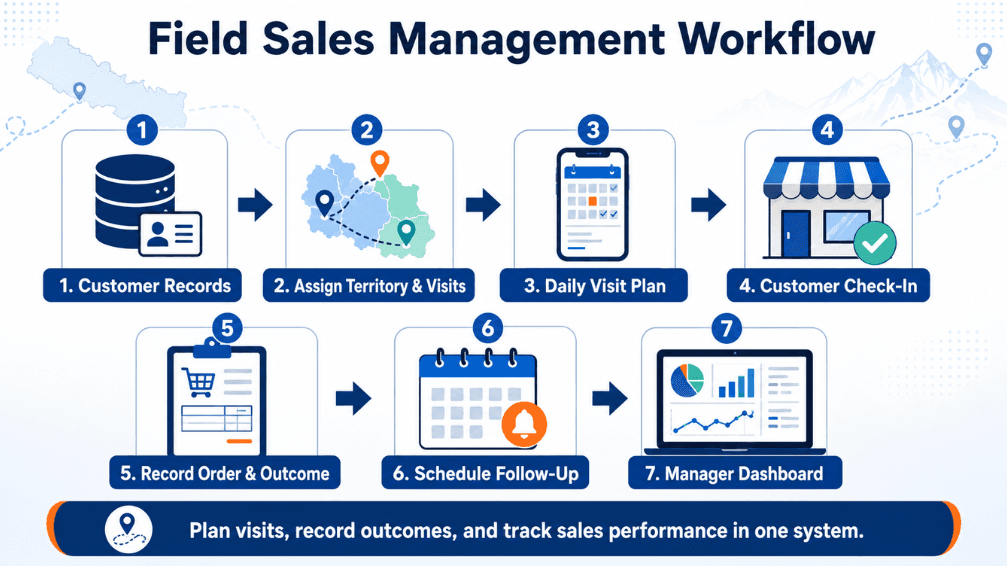
The system connects customer records, territory planning, sales visits, orders, follow-ups, and manager reporting.
Visit assignments, follow-up reminders, order updates, and management reports can also become part of a wider business automation software solution in Nepal.
This is practical field sales automation. It does not replace selling skills; it removes repetitive reporting and makes sales easier to follow.
Main Benefits for Businesses in Nepal
The first benefit is visibility. Managers can see completed work without calling every representative and support employees facing delays or weak leads.
Central records also protect customer information when an employee changes roles or leaves. A new representative can review account history before making contact.
Other important benefits include:
- Fewer missed follow-ups
- More consistent sales reporting
- Faster order communication
- Clearer territory coverage
- Better accountability
- Easier performance comparison
- Less duplicate data entry
- Faster decisions based on current information
Good sales tracking software in Nepal measures quality, not only activity. Reports should connect visits with qualified leads, quotations, orders, repeat purchases, or collections.
Features to Look for Before Choosing a System
Start with the business problem, not the longest feature list. A small team may need customer records, visit planning, notes, reminders, and simple reports. A larger organization may need multiple territories, approval levels, product catalogues, order capture, distributor records, offline use, and integrations.
Important features include:
- A simple mobile interface
- Role-based access
- Customer and lead history
- Visit planning and follow-up reminders
- Configurable visit outcomes
- Order and product information
- Territory and route management
- Dashboard filters and exports
- Offline data entry where internet access is weak
- Secure backups and reliable support
When comparing a mobile sales app in Nepal, test it with daily users. A complicated application may produce poor data. The system should reduce reporting work, not add unnecessary steps. If standard products cannot support your territories, visit process, approval rules, reports, or integrations, custom software development in Nepal may provide a better fit.
Field Sales Software vs CRM Software
Customer relationship management software and field sales software are related, but they are not always the same. A CRM usually manages leads, sales stages, communication, quotations, and customer relationships across the whole organisation. Field sales software focuses more closely on visits, territories, mobile reporting, and work completed outside the office.
Some businesses can use mobile-friendly CRM software in Nepal to manage leads, customer communication, quotations, and follow-ups. Others need a field-focused system connected with their CRM or accounting platform. The best setup depends on where and how the selling process happens.
Choose a field sales system when physical visits, route coverage, shop-level orders, or territory activity are central to revenue. Choose a general CRM when most selling happens through calls, email, online meetings, or an office-based team. A combined solution may be better when inside-sales and field-sales employees share the same customers.
How to Implement the Software Successfully
Software alone will not fix an unclear sales process. Before implementation, define what counts as a visit, which details must be recorded, who owns each lead, and when a follow-up becomes overdue. Keep required fields limited to information the business will actually use.
Begin with a small group or one territory. Import clean customer records, train users with realistic examples, and collect feedback during the first few weeks. Managers should use the reports consistently so employees understand that accurate data supports real decisions.
Avoid using field employee tracking software only as a surveillance tool. Explain what is collected, why it is needed, who can access it, and how it benefits the team. Focus on customer coverage, follow-up quality, and sales outcomes rather than monitoring every movement.
After launch, measure reporting time, follow-up speed, and data accuracy. Improve the workflow based on real use.
Conclusion
Field sales management software gives growing businesses a clearer way to plan visits, protect customer information, manage follow-ups, and understand performance. It is most valuable when manual reports, personal contact lists, and disconnected spreadsheets make sales activity difficult to manage.
The right solution should be easy for representatives, useful for managers, secure, and flexible enough to match the actual sales process. Before investing, identify the main problems, involve the sales team, test the mobile experience, and agree on measurable goals. With careful implementation, field sales management software in Nepal can turn daily field activity into reliable information and more consistent sales execution.
If your sales team relies on paper reports, chat messages, or disconnected spreadsheets, discuss your field sales requirements with Infobytes Nepal to identify a practical solution for your workflow.
Frequently Asked Questions
Which businesses can use field sales management software?
It is valuable for distributors, wholesalers, FMCG companies, pharma companies, service companies, finance teams, manufacturers, and organizations whose employees visit their customers.
Can field sales software work with weak internet access?
Some systems support offline data entry and synchronize information when a connection becomes available. Confirm this feature if representatives work in areas with unreliable mobile data.
Is GPS tracking necessary?
It depends. There may be some use for visit verification, but the tracking should be appropriate, proportional, and based on actual work requirements.
Can it connect with accounting or inventory software?
Yes, if the systems provide options for integration. The integration will allow linking of customer orders, inventory, payments, and sales reporting.

Written by
Kritika Ghimire
SEO & Digital Marketing Intern
Kritika works on search visibility and the content behind it, and writes about what actually moves a page up the results for a business in Nepal.
More about Kritika