Custom Software vs Ready-Made Software: Which Is Better for Your Business in Nepal?
Compare custom software vs ready-made software by cost, speed, flexibility, and growth to choose the right solution for your business in Nepal.
 Kritika Ghimire10 min read
Choosing the right business software can be difficult when every provider promises faster operations, lower costs, and easier growth. The custom software vs ready-made software decision depends on your budget, workflow, timeline, team, and future plans. Ready-made software offers a faster and more affordable starting point, while custom software provides greater control and flexibility. This article compares their costs, benefits, limitations, security, scalability, and implementation time. By understanding these differences, businesses in Nepal can select software that solves their real problems without paying for unnecessary features or investing in a system they may quickly outgrow.
What Is Custom Software?
Custom software is a digital system designed specifically for one business or group of users. Instead of forcing employees to change their daily activities, it can be designed around the company’s existing workflows, objectives, challenges, and reporting requirements.
Businesses considering custom software development in Nepal should work with a team that can analyze, design, develop, test, and maintain the system. The business should also have clear control over features, user permissions, reports, integrations, and future improvements.
Custom software needs extensive planning and a relatively larger initial cost compared to other types of software. But it cuts down repetitive activities and is suited for unique procedures. This is ideal for specialized processes, complicated approvals, and future plans.
What Is Ready-Made or Off-the-Shelf Software?
Ready-made software is a prebuilt solution designed for many businesses with similar requirements. It is also commonly known as off-the-shelf software. Such software is also referred to as off-the-shelf software. Examples of prepackaged software include accounting software, CRM, office suites, payroll solutions, project management tools, and regular e-commerce software.
Such software is purchased by means of licensing or subscription. Given that ready-made software is developed and tested beforehand, you will just have to set some parameters, import information, and start using it immediately. Some training materials and technical support may be provided as well.
The key benefit is convenience. Ready-made software is cheaper upfront and works perfectly fine for simple business processes. Nevertheless, the process will have to change in accordance with the software, and some features will not be present. It is the best choice if needs are typical and there is a lack of money and time.
Custom Software vs Ready-Made Software: Key Differences
The clearest way to compare custom software vs ready-made software is to look at how each option affects daily operations and long-term growth.
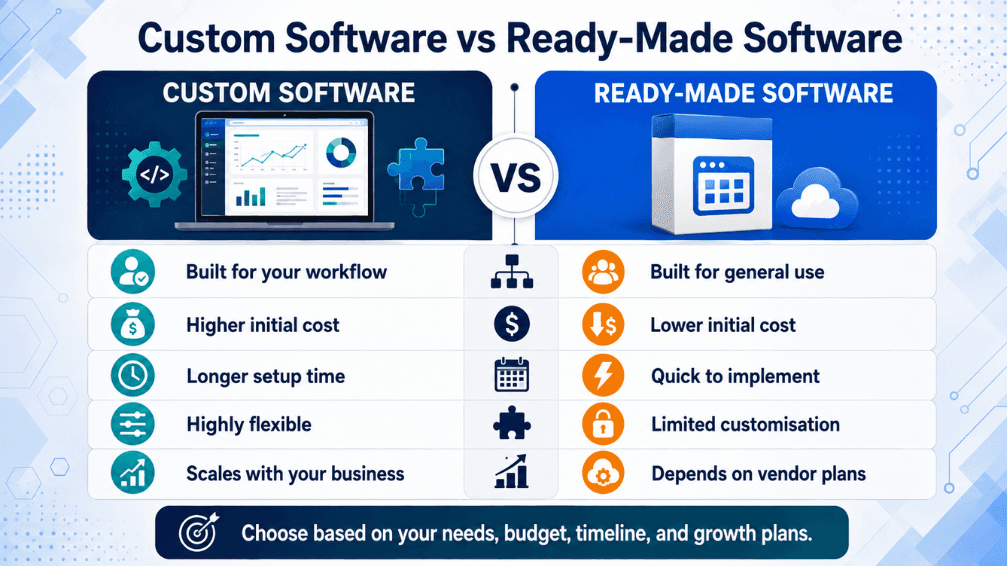
Neither option is automatically better. A small company with standard accounting needs may prefer a ready-made package. A growing company with unusual approvals, multiple branches, or disconnected systems may benefit from a custom solution. The right choice solves the real problem at an acceptable cost and risk.
Benefits of Custom Software for Businesses in Nepal
The most prominent advantage of custom software lies in improved operational fit. The software can mirror your employees' workflow with regard to local approvals, branches, reports, and customer service procedures. That may minimize such issues as manual data input, duplicate entries, reliance on spreadsheets, and errors due to the transferring of data across various systems.
Custom software solutions in Nepal may ensure flexibility. Various modules, permissions, dashboards, and integration options can be implemented as the business expands. All of that may be integrated into one solution to bring visibility of sales, inventory, operations, and reports to managers.
All those advantages are highly dependent on thorough planning. Badly defined requirements may lead to delays or unnecessary functionality implementation. Thus, you should first define your key challenges, set priorities, and agree on maintenance before starting. Custom software is the best choice for meeting measurable objectives rather than simply replicating manual processes.
Benefits of Ready-Made Software for Businesses in Nepal
Ready-made software is advantageous because it provides solutions for standard issues with no need for a costly development project. A business may try a free trial version, compare different plans, and adopt the program within days. That is why it can be used by startups, small firms, or organizations that want to find a quick solution.
The reduced entry cost is another positive point. The cost per month will help to manage expenses better, and there could be additional services like updates, backups, or hosting included. Popular programs always offer tutorials, instructions, and integration opportunities.
For standard requirements, businesses can explore ready-made software products from Infobytes Nepal before investing in a completely custom system.
When choosing the program, it should be checked whether it supports needed currency, reporting tools, permission system, export, and other aspects. Prices in case of additional employees, regional offices, storage, and additional features should also be taken into account.
Comparing Cost, Time, and Long-Term Value
When people compare software options, they often focus only on the purchase price. A better approach is to calculate the total cost of ownership over several years. This includes setup, licenses, subscriptions, customization, training, data migration, hardware or hosting, maintenance, upgrades, integrations, and the cost of staff time lost to inefficient processes.
The custom software cost in Nepal varies because projects have different features, users, integrations, and security needs. A simple internal tool costs less than a multi-branch platform requiring extensive design and testing. A responsible provider should understand the requirements before giving a clear scope, timeline, payment plan, and support terms.
Ready-made software normally has a lower initial cost, but subscriptions can rise as the team grows. Custom software takes longer to launch but may create greater value if it removes inefficiencies or replaces several subscriptions. Compare both options over three to five years, not just the first month.
Security, Data Control, Integration, and Support
The question of security should be raised at the very outset of the process. For off-the-shelf solutions, the vendor takes care of the infrastructure management, updates and the platform security. Such an option might be convenient for the company without its own technical department. The client would nevertheless have to manage proper passwords, access rights, employee access, data management and backup/export procedures. It also should know where the data will be stored and what will happen in case of termination of the subscription.
A custom-made solution gives more control over access, data flow, logging, hosting and other aspects. However, custom software is not automatically secure. Its security depends on development quality, access controls, testing, monitoring, regular updates, reliable backups, and ongoing technical support.
Make a list of systems which have to be integrated into your solution, for instance accounting system, payments, inventory, SMS gateway, e-mail or reports. Make sure that secure integration options are available.
Find out response time, training, documentation, maintenance, data recovery, emergency support etc. It concerns both standard business solutions in Nepal and custom-made platforms. Companies dealing with repeated data entry, disconnected reports, and manual approvals may also benefit from business automation software in Nepal
Which Type of Software Is Right for Your Business?
Ready-made software is usually suitable when your processes are common, your budget is limited, and you need a solution quickly. It can be a good choice for a startup testing its business model, a small team with simple requirements, or a company that does not need deep integration or unique features.
Custom software is more suitable when standard tools create workarounds, key activities depend on spreadsheets, or employees enter the same data in several systems. It also suits specialized services, multiple branches, unusual reports, strict integrations, or rapid growth. Before deciding, answer these questions:
- What business problem must the software solve?
- Which features are essential, and which are only desirable?
- Can a standard product support at least the essential requirements?
- How much time and money are current inefficiencies costing?
- How many users, branches, or transactions are expected in three years?
- Who will manage implementation, training, data, and support?
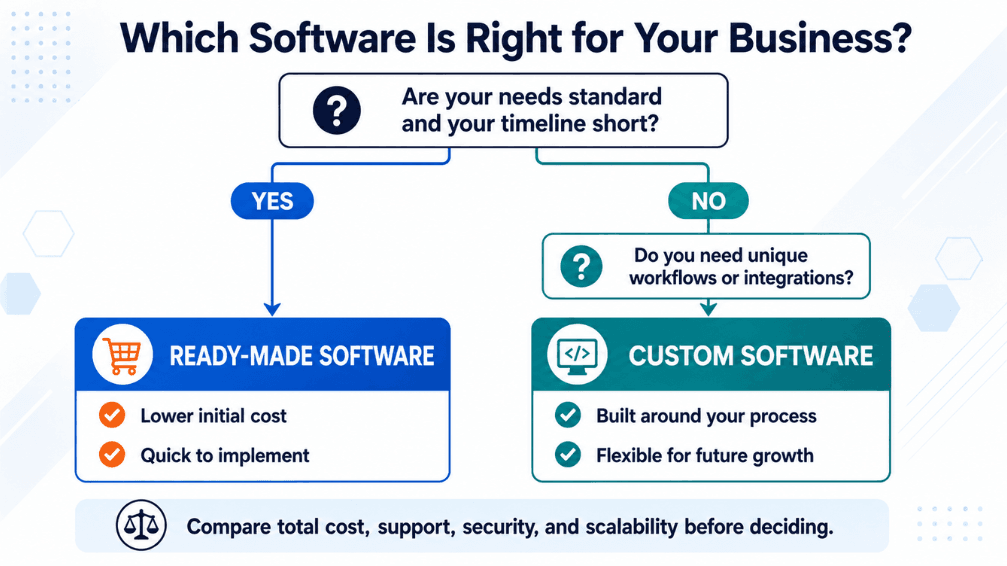
A hybrid approach may also work: use standard tools for common functions and custom software for unique processes. Invest only where customization creates clear value. For businesses mainly struggling with scattered customer records and missed sales follow-ups, a configurable CRM software solution in Nepal may provide the right balance between a general product and a fully custom platform.
How to Choose a Software Development Company in Nepal
If custom development is the better option, choosing the right partner is as important as choosing the technology. A reliable software development company in Nepal should begin by asking about your business goals, users, workflow, risks, and expected results. Be cautious if a provider gives a final price before understanding the project in enough detail.
Review relevant work, client feedback, technical ability, communication, testing, and experience with similar problems. Ask who will manage the project and how often progress will be demonstrated.
The contract should cover scope, milestones, payment, changes, hosting, data and source code ownership, security, warranty, maintenance, and exit arrangements. Also ask how existing data will be transferred.
Start with discovery or a small first release covering the highest-priority workflow. Employees should participate in planning and testing because their feedback reveals practical issues. A good partner should also recommend a ready-made product when custom development would not provide enough value.
Conclusion
Selection of custom vs ready-to-use software is based on many factors like fitment, costs, time taken, control, scalability, etc. Ready-made software is usually quick to implement, inexpensive, and sufficient to take care of regular business functions. Custom software is costly and takes much effort to implement, but it can be designed to meet specific requirements, integrate critical systems, and grow as per the organizational needs.
Cost and functionality alone should not be considered to make a decision. Define the need, specify the core requirements, assess the cost involved for multiple years, and think about maintenance risks. If a ready-made system is able to fulfill your requirements without any complicated implementation hacks, then that might be the best option. Otherwise, a properly planned custom software solution might suit you in Nepal.
If you are still unsure which option fits your workflow, discuss your software requirements with Infobytes Nepal before making a final investment.
Frequently Asked Questions
What is the main difference between custom and ready-made software?
Custom software is tailored specifically to the process and needs of a single company. Ready-made software is designed for multiple people and has standard capabilities that can be configured by the company within the options provided by the software provider.
Is custom software more expensive than off-the-shelf software?
Custom software is typically more expensive upfront because it needs to be planned, designed, developed, tested, and deployed. Ready-made software has a lower upfront cost, but subscriptions, additional users, premium options, and integration will increase the total cost.
How long does custom software development take in Nepal?
It depends on the scale of the project. Creating a simple first version might take several months, but a large and complex platform might take longer. It will be helpful to have clear requirements, quick feedback, and phased release.
Can ready-made software be customized?
Most of the ready-made solutions provide the possibility to customize settings, forms, dashboards, user permissions, and integrations. Still, the customization is bound to the platform of the software provider, so sometimes it is not possible to support an important workflow, and custom software becomes necessary.
Should a small business in Nepal choose custom software?
A small business should choose custom software only when it solves an important problem that available products cannot handle efficiently and the expected benefits justify the investment. For common needs and limited budgets, ready-made software is often the practical starting point.

Written by
Kritika Ghimire
SEO & Digital Marketing Intern
Kritika works on search visibility and the content behind it, and writes about what actually moves a page up the results for a business in Nepal.
More about Kritika