Barcode Sample Tracking Software Nepal: A Practical Guide for Laboratories
Discover barcode sample tracking software in Nepal for faster sample identification, tracking, result verification and smoother laboratory workflows.
 Kritika Ghimire8 min readUpdated 29 September 2026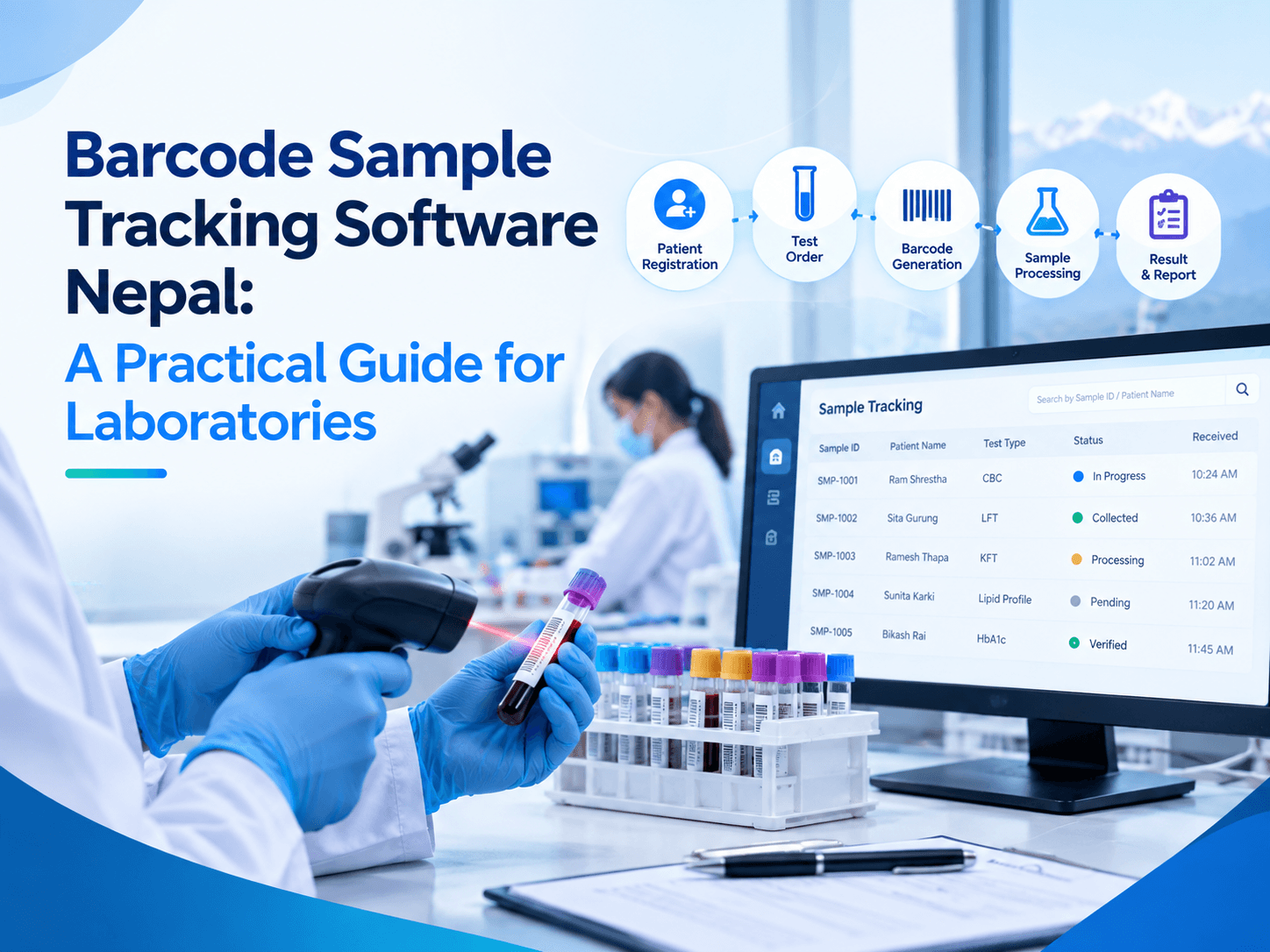
A medical laboratory processes a lot more than test results. Samples are transferred every day from patient registration, collection to testing, reporting, verification and delivery. As the laboratory expands, it can become challenging to track all samples using these methods when using handwritten labels, spreadsheets, and separate systems. Here's where the barcode sample tracking software in Nepal can help.
Each sample has a unique identity and is correlated with the patient's test information through a barcode. Laboratory personnel will no longer have to look through registers and manually add the same information time after time; instead, they can follow a sample as it progresses through the testing process.
Nidanyo by Infobytes Nepal is a complete solution for laboratories by providing barcoded sample collection and tracking, patient registration, report printing, billing, inventory management and other laboratory operations.
What Is Barcode Sample Tracking Software?
Sample tracking software for barcode is an application used in the lab, which uses a unique barcode label to identify and track samples throughout the testing process.
A typical process can look like this:
Patient registration → Test order → Barcode generation → Sample collection → Sample tracking → Result entry → Verification → Report release
The important part is that the barcode is connected to the patient's digital record and test order.
For instance, a staff member can link the item of a sample with the relevant patient and tests when they are collected. The sample is able to be monitored in the laboratory without relying solely on handwritten records as it progresses through the laboratory.
This is more than just a label printer. It integrates into the overall process of the laboratory.
Why Do Laboratories in Nepal Need Sample Tracking?
Manual sample handling can become increasingly difficult when patient and test volumes increase. A laboratory needs clear procedures for identifying, handling, processing, and tracking samples throughout the testing workflow. WHO's laboratory quality management guidance also emphasizes sample management as an important part of laboratory quality, including collection, labelling, processing, tracking, storage, and disposal.
A laboratory may face problems such as:
- Difficulty finding a particular sample
- Similar patient names causing confusion
- Repeated manual data entry
- Limited visibility of pending samples
- Delays in processing or verification
- Difficulty identifying overdue work
- Records spread across different systems
- More paperwork between collection and reporting
A laboratory sample tracking system brings these activities into a more structured digital workflow.
Nidanyo, for example, allows samples to carry a barcode from collection onward, so laboratory staff can see what is being processed, what is pending, and what is overdue.
How Does Barcode Sample Tracking Work?
The process begins when a patient visits the laboratory.
First, the patient is registered and the required tests are selected. A barcode is then associated with the sample during collection.
The sample moves through the laboratory while remaining connected to its digital record.
A simplified workflow is:
- 1Register the patient.
- 2Select the required tests.
- 3Generate the sample barcode.
- 4Collect and label the sample.
- 5Process the sample in the laboratory.
- 6Enter or receive the test result.
- 7Verify the result through the required approval process.
- 8Release the final report.
This creates a connection between the patient, test order, physical sample, result, and report.
Nidanyo also supports result entry and authorised verification as separate steps, so a result does not simply become releasable immediately after entry.
Benefits of Barcode Sample Tracking Software in Nepal
1. Faster Sample Identification
A unique barcode makes it easier for laboratory staff to identify a sample without relying only on patient names or handwritten information.
This becomes particularly useful when a laboratory handles many samples during busy hours.
2. Better Sample Visibility
With a digital tracking system, staff can have a clearer view of where samples are within the workflow.
Instead of asking another employee whether a sample has been processed, staff can check its status in the system.
3. Less Repeated Data Entry
Manual transcription creates unnecessary work and opportunities for mistakes.
When patient and test information is already stored digitally, staff do not need to repeatedly write the same information at different stages.
Nidanyo can also receive results from analysers that support standard interfacing, reducing manual result transcription for supported machines.
4. Easier Management of Pending Work
A growing laboratory needs to know which samples and results still require attention.
Barcode-based tracking can help separate completed work from pending or overdue work, making it easier for staff and managers to follow up.
5. Better Traceability
When a sample is connected to its digital record, the laboratory has a clearer history of its progress through the workflow.
This can be useful when investigating delays, corrected results, or other workflow issues.
6. Connects With Other Laboratory Operations
Barcode tracking becomes more useful when it works together with other laboratory functions.
Nidanyo combines sample tracking with patient registration, result management, report generation, billing, reagent and consumable inventory, role-based access, audit trails, and operational reporting.
What Should You Look for in Barcode Laboratory Software Nepal?
Not every system that can generate a barcode is a complete laboratory management solution.
When comparing barcode laboratory software in Nepal, look at the complete workflow rather than the barcode feature alone.
Important areas to check include:
- Patient registration and duplicate detection
- Barcode sample collection
- Sample status tracking
- Test management
- Result entry
- Result verification
- Report generation
- Billing
- Inventory management
- User permissions
- Audit history
- Pending-work reporting
- Multi-branch support
- Analyser interfacing where required
This is especially important for diagnostic centres and laboratories that are growing beyond a single collection counter.
You can also compare the wider features of Nidanyo lab software before deciding which type of system fits your laboratory.
Barcode Tracking vs Manual Sample Tracking
The difference becomes more noticeable as sample volume increases.
| Manual Tracking | Barcode-Based Tracking |
|---|---|
| Relies heavily on registers | Uses digital sample records |
| Manual sample identification | Barcode-based identification |
| Difficult to check status quickly | Sample status can be viewed digitally |
| More repeated writing | Less repetitive data entry |
| Pending work can be difficult to identify | Easier pending-work visibility |
| Information may be spread across tools | Patient, sample and test information can stay connected |
Barcode technology does not replace laboratory procedures or trained staff. It provides a structured way to identify and track samples within those procedures.
Is Barcode Tracking the Same as LIS or LIMS?
Not exactly.
Barcode tracking is a feature within a laboratory information or management system.
An LIS generally focuses on laboratory information such as patients, tests, results, and reports. A LIMS generally places greater emphasis on samples, workflows, and laboratory data management.
Nidanyo uses the term LIOMS - Lab Information and Operations Management System. It combines laboratory information management with operational functions such as billing, inventory, permissions, reporting, and branch management.
If you are searching for LIS software Nepal, LIMS software Nepal, or broader LIOMS Nepal solutions, it is therefore important to compare what the software actually covers rather than comparing the names alone.
Barcode Sample Tracking With Nidanyo
Nidanyo is laboratory software from Infobytes Nepal designed for medical laboratories, diagnostic centres, pathology labs, and polyclinics in Nepal.
Its barcode workflow starts with sample collection and keeps the sample connected with the relevant patient and test information.
The wider system also covers result entry and verification, report printing and delivery, billing, referring doctor and institution commissions, reagent and consumable inventory, role-based access, audit trails, turnaround-time reporting, and multi-branch or collection-centre workflows.
For laboratories comparing laboratory management software in Nepal, this connected approach can be more useful than choosing a standalone barcode-label solution.
Questions to Ask Before Choosing Sample Tracking Software
Before purchasing sample tracking software in Nepal, ask the provider:
- Can every sample receive a unique barcode?
- Is the barcode connected to the correct patient and test order?
- Can staff check sample status?
- Can pending and overdue samples be identified?
- How are results verified before report release?
- Can the system connect with supported analysers?
- Can it handle multiple branches or collection centres?
- Does it include billing and inventory?
- How are user permissions controlled?
- Is there an audit trail?
- What happens if the internet goes down?
- What training and support are provided?
These questions help you evaluate the actual workflow instead of choosing software based only on a feature list.
Why Barcode Tracking Matters as a Laboratory Grows
A small laboratory may manage its samples manually for a period of time. But as patient volume, staff, departments, and collection centres increase, keeping track of every sample becomes more demanding.
A barcode gives each sample a clear digital identity.
When that identity remains connected to registration, testing, results, verification, reporting, billing, and inventory, the laboratory gets a more organized workflow.
For businesses looking for medical laboratory software in Nepal, barcode tracking should therefore be considered as part of the complete laboratory system rather than as an isolated feature.
Conclusion
Barcode sample tracking software Nepal can help laboratories make sample identification and tracking more organized, especially as testing volume grows. The real value is not simply printing a barcode. It is keeping that barcode connected to the patient's record, test order, sample status, result, verification process, and final report.
Nidanyo by Infobytes Nepal brings these functions together in a LIOMS designed for medical laboratories, diagnostic centres, pathology labs, and polyclinics in Nepal.
If your laboratory is still relying heavily on registers and manual sample tracking, moving to a connected digital workflow can make it easier to know which sample belongs to whom, where it is in the process, what still needs attention, and whether the result is ready for release.
Frequently Asked Questions
What is barcode sample tracking software?
It is laboratory software that assigns a unique barcode to a sample and connects it with the patient's and test's digital information throughout the laboratory workflow.
Is barcode tracking part of an LIS or LIMS?
Yes. Barcode tracking can be a feature within laboratory information and management systems. Nidanyo is positioned by Infobytes as a LIOMS that combines laboratory information with operational management.
Can barcode tracking reduce manual work?
It can reduce repeated identification and data entry, while making sample status easier to follow. Proper collection procedures and trained laboratory staff are still essential.

Written by
Kritika Ghimire
SEO & Digital Marketing Intern
Kritika works on search visibility and the content behind it, and writes about what actually moves a page up the results for a business in Nepal.
More about Kritika